I will begin by making a few important disclaimers.
First of all, I have no formal education or background in financial matters. Anything that I discuss is strictly from the perspective of my own personal experiences and an appreciation of the concerns and challenges presented by living on the autism spectrum; it should not be regarded as professional or expert advice.
Second, I have always been very self-conscious, ever since my ASD diagnosis over 25 years ago, about my own financial independence after learning of the alarmingly high unemployment rates in the autism community and the small percentage of autistic adults who attain such independence. My career of nearly 30 years as an electronics engineer in research and development laboratories made possible for me what eludes a large portion of the ASD community, although I have always believed that it is considerably more common because many financially independent autistics are never identified or diagnosed.
Nevertheless, many of the issues that I will be addressing are of importance to much of the autistic community. Also, family members and others who provide support for autistics, as well as professionals who work with them, should be aware of these and learn to recognize signs of the hazards and pitfalls I will discuss.
Scams and Cons
For me, the most disturbing (and even frightening) financial concern, where autistics are involved, is the possibility of falling victim to a scam or con. It is often said that, under the right circumstances, anyone can become a victim of such – this is especially true in the present day. Because autistics are often unable to detect when another person is trying to deceive them (this ability is connected to theory of mind, which autistics are often deficient in), they are especially susceptible to these kinds of subterfuge and hence fall victim to scammers and con artists.
Although scams and cons have probably been around for all human history, the advent of the internet, social media, and most recently artificial intelligence have made possible an unprecedented and massive explosion in such activities. What might have happened only occasionally in the past now occurs almost daily for just about everybody. For example, the well-known Nigerian email scam (in which the recipient is asked to send money to free a wealthy imprisoned individual in exchange for a substantial portion of their estate after they are released) is nothing more than a modern version of the so-called “Spanish prisoner” con that dates back to the 19th century.
The perpetrators of scams and cons famously take advantage of their victims’ emotional states. Also, the problems of isolation and loneliness in Western society have risen to epidemic proportions; as such, more people than ever are prepared to believe dubious claims, especially when the prospects of friendship and romance also present themselves. Once again, autistics (who frequently have difficulty finding and are desperate for such) are perfect targets for these schemes. A common one nowadays is the “romance scam” – a form of confidence game in which the victim, often through the internet and social media, becomes involved with a person (whom they have never met) who then proceeds to ask for money (often large sums, up to and including life savings) and subsequently vanishes. The number of people who fall for such scams has risen dramatically and includes highly educated and knowledgeable individuals – there have even been cases of security professionals (I am not kidding!) becoming victims of such. In view of all this, the risks for autistics are nothing short of frightening. This is especially true for those who live on special-need trusts or retirement savings which constitute their primary (if not sole) means of support for the remainder of their lifetimes.
The most terrifying of these scams, however, is the so-called “long con,” in which a perpetrator forms a relationship (often romantic) with the victim that lasts for an extended period of months, sometimes years, to gain their trust, and then proceeds to con them of significant assets and even their life savings. Because they have known the scammer for such a long time, the victims are not wary that this person might be taking advantage of them. Yet again, autistics, for whom such relationships are often hard to come by and who are unable to detect deception, are especially vulnerable to such methods.
It has become conventional wisdom that anybody can be the victim of a scam or fraud. In my opinion, the most effective prevention against such is to be as knowledgeable as possible about the various forms that are currently perpetrated and have been used in the past. For me, this even became a specialized interest. The AARP provides excellent resources for individuals of all ages, in the form of frequent articles and the AARP Fraud Watch Network. I especially recommend these and also like true-crime and reality TV programs that involve scammers (the only ones in either category that I ever watch). All of this makes me more aware of the hazards we are all susceptible to; it is especially interesting to learn about the sneaky and convoluted schemes that these perpetrators come up with! I advise all autistics, particularly those who are financially independent, to familiarize themselves with these risks as much as possible. Also, family members and friends of autistics, not to mention professionals who work with them, should learn to recognize tell-tale signs that an autistic person is falling victim to a scam.
Credit Card and Bank Account Fraud
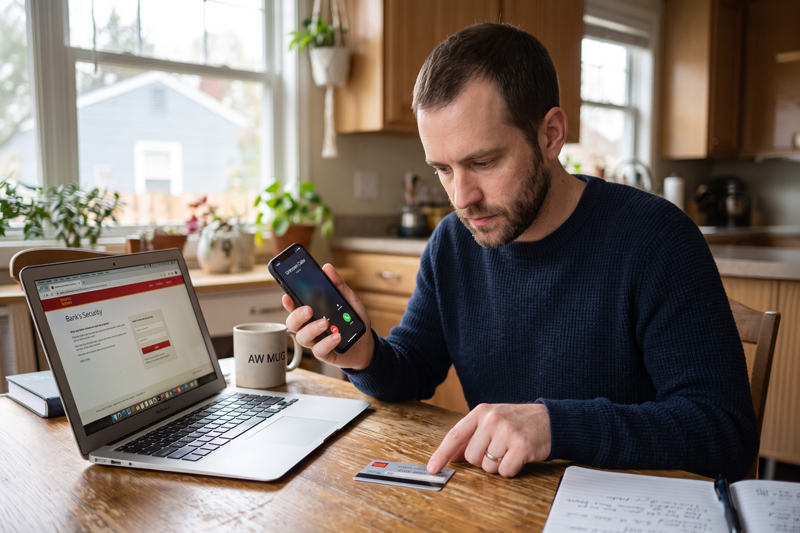
Probably the most common forms of fraud to which we are all susceptible involve the hacking of credit/debit cards and other accounts. This can happen directly over the internet, or by contacting a victim and tricking them into providing information that gives the perpetrator access to the account – I have personally experienced attempts of both kinds.
Direct hacking is not always easy to prevent, although good security (e.g., strong passwords and two-factor authentication) for larger and more sensitive financial and other accounts can help to deter it. This can, however, be detected by regular monitoring of accounts. Also, security software and services that do this automatically, and notify the user of any suspicious activity, may well be worth the expense. In any case, it is always good practice to regularly check all of one’s accounts and make sure that there has not been any unauthorized access. A particularly sneaky attack on two of my credit cards involved a hacker who attempted a change of address, to which new cards would have been mailed.
In many cases, however, the perpetrator makes contact with the victim (e.g., by email or telephone) and persuades them to reveal sensitive personal (e.g., birth date or social security number) or account (debit/credit card number, bank account number, check routing number, password, etc.) information and uses it to access the account. This also takes the form of fake websites that look virtually identical to those of banks, credit cards, cash payment services, and other legitimate institutions. These hazards are best avoided by never giving sensitive information to anyone other than known, authorized individuals reached through telephone numbers that appear on the backs of credit and debit cards or on account statements received directly from the institution. When using the internet, directly entering the correct web address for an institution or payee is always preferable to using a link on an email that may well be fraudulent. Also, the three-digit security code on the back of a credit or debit card should never be given to anybody, under any circumstances, other than an authorized payee whose identity one is absolutely certain of – it is not uncommon for hackers to obtain a user’s card number, address, and telephone number and thereby pose as legitimate representatives in order to obtain this code from a victim and thereby gain unrestricted access to their account.
All of these are straightforward safety rules and preventative measures that financially independent autistics can easily learn, and the importance of following them cannot be overemphasized. Occasionally, however, one encounters a trick so devious that one does not recognize it until it is too late. A scary example that I learned about some years ago involves the victim receiving a call from a hotel desk or vendor that one just made a transaction with. They provide enough information to appear legitimate and then ask for the card number or security code (which they “inadvertently” copied incorrectly). This is so innocuous that anybody could easily fall for it, regardless of their knowledge, wariness, or emotional state – I may well have fallen for this one myself, had I not read about it previously! Once again, the best prevention is to become as aware as possible of schemes and tricks that are in use once they become known.
Financial Pitfalls for Autistics
Neurotypicals often find themselves in massive debt (usually credit card), to the point of bankruptcy, as the result of excessive spending. In many cases, this happens because they absolutely “must have” the “latest” item, be it clothing, décor, or other that is currently in fashion and “just cannot do without.” Autistics are generally not as aware or concerned about current fashion and, as such, are able to avoid this kind of situation. It is not difficult to educate a financially independent autistic to not spend beyond their means on such unessential items and thereby not get into financial difficulties.
Of the more traditional vices, gambling nowadays presents a greater risk to autistics than ever. Wagering on sports, which was traditionally done through a “bookie,” is now routinely done on sports betting sites online. For autistics with a strong interest in sports, particularly those who like to follow statistics, this can have a strong attraction and constitutes an enormous potential hazard. The same holds for the newer prediction markets, because, once again, many autistics are interested in (and very good at) various kinds of trivia on which they can now place wagers (officially regarded as “trades”). Even traditional investing (stocks, bonds, commodities, etc.) is now routinely done online and presents yet another hazard. Because these things are all done over the internet without the need for human social contact, they are especially dangerous for asocial autistics who might otherwise not make such connections and can now engage in unrestrained and unsupervised activity.
Other major financial risks for an individual on the spectrum are those involving their special interests. Although not as likely to spend an extravagant amount on traditional items, they may nevertheless be willing to spend more than they can afford on ones that pertain to a strong specialized interest. For example, someone interested in comics may be tempted to buy an expensive rare issue that is beyond their means. In my own childhood, I was a coin collector and might easily have wanted to purchase a rare date if I had the resources. Also, as a science and electronics enthusiast, devices and equipment of just about any kind also presented great temptation, regardless of whether I even had any use for them.
A related risk involves attractively priced items that might be counterfeit or even stolen. On one occasion while visiting the southwestern US, I encountered an individual who specialized in selling meteorites. I was ready to make a purchase from him, until I realized that some of his specimens were probably fake – it helps to have a good knowledge of one’s special interest (which many autistics do). We need to be aware of such hazards, as should anybody who supports or assists us.
Finally, although an autistic person might not know or care about what is in fashion, they may still be persuaded to buy such an item if they are somehow convinced that it will make them more attractive or popular and thereby find friends or even romantic partners – advertisers are especially good at doing this. I remember commercials and ads for various products ranging from personal care to clothing to automobiles that used these methods and, as an adolescent, made very strong and lasting impressions on me even though I was too young to even have those items. In reality, attempts on our part to use such goods in this manner result in nothing but embarrassing failures; this is a common autistic story. An article of clothing that looks attractive on a model in a magazine will appear nothing short of ridiculous on a person like myself. Yet again, we need to be unmistakably assured that such products will not provide any benefits for us and are a waste of money which we may not even have.
More Routine Matters
I have long observed that, as with many other aspects of daily living, much of our financial lives consist of regular routines. For instance, most bills (rent, utilities, etc.) are paid monthly, usually on the same days of the month. Others are quarterly, semiannual, or yearly. In any case, this should not be difficult for the many autistics who famously are drawn to regular routines.
As to purchases of household, personal, and sometimes food products, many autistics have strong preferences for very specific items, which they repeatedly use on a continuing basis. In such cases, I personally like to purchase nonperishable items in larger quantities, especially when they are on sale or bulk discounts are offered. This allows me to “lock in” on savings and makes the need to go shopping for them less frequent (an activity that I absolutely hate for anything other than my special interests).
Also, since I am good with numbers (yes, an autistic stereotype, but it nevertheless applies to some of us), I have always prepared my own tax returns. This has become easier with financial software (to which I directly download information from all my accounts), along with tax software (to which I import data from the former as well as tax documents). In any case, it forces me to regularly monitor all my finances – an essential habit to get into. For autistics who can do these things themselves, I strongly recommend they do so. At the very least, they should have some involvement in these matters.
Finally, the importance of long-term financial planning cannot be overemphasized. For autistics who have regular employment, retirement planning is essential and needs to be started as early as possible. Now that employers no longer provide pensions as a standard benefit, and staying with the same employer is a thing of the past, retirement accounts (employer-based 401(k) and/or personal IRA) need to be arranged and managed by the employee. For those who do not, special needs or other planning must be made. If at all possible, the services of a financial planner should be obtained, since long-term financial decisions have become too complicated for most individuals to make on their own. There are even planners who specialize in the concerns of individuals with disabilities and have given presentations at autism conferences.
In all, the current age presents a variety of financial challenges and hazards that need to be addressed by our community.
Karl Wittig, PE, is Advisory Board Chair for Aspies for Social Success (AFSS). Karl may be contacted at [email protected].