
It is now widely accepted that special interests, for autistics, can serve as a powerful motivational tool, and in many cases present the only opportunity they have for future employment and independent living. This has been recognized by such prominent autistics as Temple Grandin and Stephen Shore, among others. It is also a welcome change from the traditional attitude that excessive interest of any kind is unhealthy and should be discouraged, and that the ideal of becoming “well-rounded” should be emphatically stressed. I doubt that this is beneficial for anybody, but for autistics it is nothing less than destructive and can result in tremendous frustration and anger, not to mention missed opportunities. Autistics are better served by learning about and participating in things that they have interest in and aptitude for, and which can provide satisfaction and perhaps a future occupation, than they are by the traditional practice of imposing things for which they have neither, and results in little or no benefit.
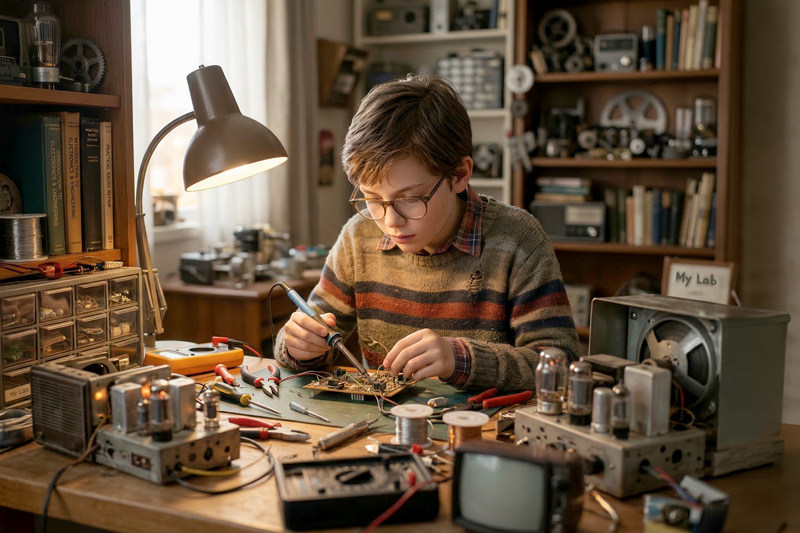
In my own case, I was always interested in anything mechanical, electrical, or electronic, and liked to take apart, tinker with, and repair such devices, going back to early infancy. This led to, and was very influential in, my becoming an electronics engineer, and having a career that lasted nearly 30 years. It also provided me with a hobby of restoring old, vintage, and antique electronic equipment, scientific and laboratory instruments, as well as mechanical and other devices. I have done this for most of my life and, being retired from my occupation, am doing so to this day – I use these to decorate my apartment.
A Very Early Obsession
I recall hearing stories from my family that, from a very early age, I had great interest in anything with moving parts, or which could be taken apart. I was fascinated by mechanical devices such as locks (which I would repeatedly open and close), and anything electrical (I would turn light switches on and off in a similar manner). This sometimes resulted in embarrassing incidents, such as setting off a store burglar alarm on at least one occasion. Not long after learning to talk, I would incessantly perseverate about my interest in anything mechanical or electrical. The latter was later recognized as the “little professor” trait of Asperger Syndrome, and the others are now regarded as classic autistic behaviors. At that time (late 1950’s to early 1960’s), however, nothing was known about this, and the word autism barely even existed. Consequently, these were not identified as the autistic manifestations they actually were. At least, though, they were seen as signs of aptitude and intelligence and hence something positive.
It is interesting that, even though my parents divorced early and I had no contact with his side of the family, my father came from a long line of engineers going back to ancestors in Germany and was himself an engineer, but my mother’s side (by which I was raised) had no such leanings, and today would be considered technophobic. Unlike many who developed such interests because of a family member, teacher, relative, or neighbor who influenced them, I had no such person in my life. Clearly, my strong inclination towards this was purely genetic, and probably connected to my then-undiagnosed autism. Nevertheless, my obsession with anything mechanical, electrical, and above all electronic (television and radio were the dominant technologies of the time) did not abate. Unfortunately, there was not much that I could do about it because, as a child, I had little access to such things or to anyone who could teach me about them.
One Man’s Trash is Another Man’s Treasure
This famous proverb applies to autistics even more than it does in general, because we are often drawn towards unusual things that most people would hardly care about. For me, however, it was true in the most literal sense. Growing up in the urban environment of New York City, where garbage is put out on sidewalk curbs for collection by the sanitation department, I would often see discarded appliances and other mechanical and electrical devices. Since they were free for the taking, I picked up any such items that I found and brought them home to take apart and examine.
At first, there was little that I could do besides look at their insides but, as I got older, I was able to figure out how they were put together, and even how they worked. Eventually, I was able to repair them and get them to work. One unfortunate result of this is that I was labelled “garbage picker.” I had been doing this since age six (if not earlier), and it became more of a peculiarity as I got older. Still, for an autistic person, the stigma of a social taboo that I could not understand (and still don’t) was not nearly as strong as my obsessive special interest. As such, I continued doing this and do so to this day (along with finds at flea markets, apartment and yard sales, thrift shops, vintage stores, as well as online).
This became especially significant when people discarded old radios, televisions, record players, and other electronic equipment, which immediately came home with me. Unlike the other devices (mainly mechanical and simple electrical), whose operation can be directly observed, one cannot figure out how electronic equipment works without specialized technical knowledge, which I did not yet have. Over the following years, a few basic books about radio and TV repair remedied that situation. I found my first TV set at age 10; I had already fixed a few radios by then but had no idea what to do with a TV. A few years later, when I was in high school, I got my first TV to work. It became a daily ritual for me to walk around my neighborhood after school in search of electronic items. Also, I can honestly say that I spent as much time looking at television from the inside as I had watching it from the front. Before long, every room of my apartment (I lived in a large extended family) had its own TV, not to mention numerous radios. My own room was filled with those precious finds.
Because I attended a science high school, the physics lab had a huge amount of laboratory equipment and instruments, many of which were not in working condition. I was able to figure out how many of these worked and often repaired them to full working order.
Things Have Changed a Lot Since Then
To this day, I consider those early experiences as important to becoming an engineer as was my formal education. Although everything that I had tinkered with (old TVs and radios with tubes) had long been obsolete by the time I began my professional career, this early activity gave me a strong practical feel for working with practical electronic devices and equipment; all of this served me very well in my later professional life. I can honestly say that those early autistic obsessions and special interests led directly to my career and may even have made it possible to begin with.
Unfortunately, nowadays, electronic devices are so compact that they can barely even be opened or taken apart, let alone repaired. As such, there are fewer opportunities for a young person who, like me, is interested in such things. After my ASD diagnosis in 2000, I often encountered parents of a kid on the spectrum who had been fixated on vacuum cleaners and loved taking them apart (these are among the few common devices that can still be disassembled and whose operation is somewhat interesting). I always told them, quite emphatically, that they should encourage this as much as possible. Even if it doesn’t lead directly to a career or occupation, it stimulates interest in how things work and provides an activity that is both enjoyable and educational. This can put them on the road to a viable educational or career path and, eventually, gainful employment.
Educational Considerations
I was also fortunate in that, not only was I capable of doing well in school (at least, according to their criteria) but also had a strong aptitude for science and math (in contrast with such subjects as English and social studies, which made little sense to me). I always liked, and did well in, what are now called STEM subjects. In addition to electricity and electronics, I became very interested in astronomy (the planetarium was my favorite school trip), the Apollo space program, atomic and particle physics, and other similar areas. Alas, the only pre-college subject in which any of these were taught was physics, which I didn’t get to take until high school.
I was especially fortunate to be good at math, which many autistics who (like me) were strongly inclined towards mechanical and electrical things did not have aptitude for. Temple Grandin has addressed this issue and points out that many otherwise technically gifted autistics were never able to do algebra. Although math was not my primary interest, I was always strongly drawn towards numbers, looked for numerical patterns wherever I could find them, and was fascinated by different number systems (e.g., Roman numerals). Thankfully, I was able to learn algebra, enjoyed geometry (particularly as it related to mechanical drawing), and especially loved trigonometry after I discovered its connection to electronics and physics.
All of this meant that I would go to an engineering school, as opposed to a four-year liberal arts college. I had the opportunity to do so, majoring in applied physics, followed by a master’s degree in electrical engineering. Had I not been able to do this, I would most likely have been a repairperson, laboratory technician, or other similar occupation. Surely many autistics have followed this path. I have always believed that unemployment rates for autistics (among the highest for any demographic, including disabilities) are greatly overestimated because many have been able to find employment related to their specialized abilities and interests and were never diagnosed.
My Autistic Career
My career as an electronics engineer was spent in research and development laboratory organizations. I worked in such areas as electronic imaging and display devices, scientific and laboratory instrumentation and, most notably, was a member of various teams that developed technologies for the digital high-definition television broadcasting standard that is in use today. The R&D environment, at least at that time, was very favorable for autistics (then undiagnosed) because it employed substantial numbers of eccentric individuals (to the point of creating stereotypes). As such, my autistic differences would have been seen as merely another form of such and were tolerated to a much greater extent than they would have been in other work environments.
Although the electronic devices that I spent so much time tinkering with in my youth, and which had largely come from discarded trash, used early technologies that were very different from the ones with which I worked during my employment, I cannot help but make a direct connection between those early experiences, which were the direct result of an obsessive autistic special interest, and the career I was later able to have. I am convinced that there is a direct line going from those old televisions that I liked to repair as a kid to my later occupation working on advanced video technologies.
Karl Wittig, PE, is Advisory Board Chair for Aspies for Social Success (AFSS). Karl may be contacted at [email protected].



Thank you for your article. My grandson, 23, just graduated from college with a degree in designing computer games. He has never worked and now must find a job in the field he loves, game design. He lives in the SF Bay Area. Have suggestions on how he should start looking?