The Miracle Project (TMP), founded in 2004, is internationally recognized as the first systematic, evidence-based program to use expressive and performing arts to improve quality of life and relationships for autistic individuals while challenging negative societal stereotypes through authentic artistic representation. A 2014 California State University, Northridge (CSUN) study, funded by the National Endowment for the Arts, demonstrated that TMP’s methodologies improved social communication, strengthened relationships with typically developing peers, reduced anxiety, and fostered more positive public perceptions of autistic individuals (Kim et al., 2015).
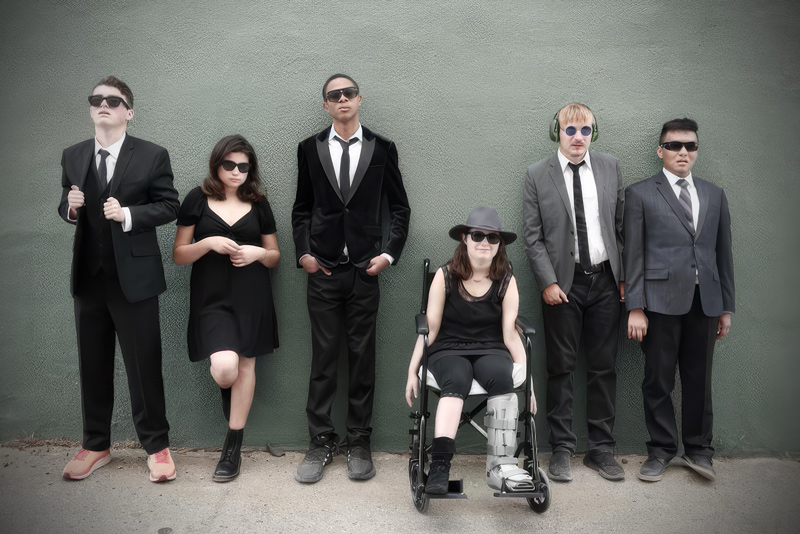
Express Yourself participants during the filming of “Let My Typin’ Let You See,” one of the program’s original music videos.
TMP welcomes minimally speaking and nonspeaking participants, including founder Elaine Hall’s son, Neal, whose experiences helped shape the organization’s philosophy. We consistently witnessed creativity, humor, insight, and artistry from people with complex communication profiles while recognizing that they remained among those most underestimated and excluded from arts education and creative opportunities.
Enter “Express Yourself.” TMP envisioned a creative arts program intentionally designed for people who are minimally speaking, nonspeaking, or unreliable speakers. Participants themselves introduced the term multimodality communicators, including AAC, typing, speech, gesture, movement, and facial expression—rather than defining people by what they cannot do. TMP received funding to develop the program in 2019, and Express Yourself was conceptualized by TMP founder Elaine Hall in collaboration with speech-language pathologist and AAC specialist Darlene Hanson; together they created a creative arts program designed around multimodal communication.
In addition, Express Yourself was grounded in the SCERTS Model, developed by Dr. Barry Prizant and colleagues, with training provided by Dr. Prizant and Dr. Amy Laurent before launch. SCERTS’ emphasis on social communication, emotional regulation, and transactional supports aligned naturally with TMP’s participant-driven creative process, reinforcing an environment where all forms of communication could be recognized, supported, and expanded through the arts. Like every TMP program, Express Yourself begins with movement. Drawing on her background as a movement specialist, Hall introduced gentle guided movement that encouraged participants to discover their own forms of physical expression. There was no right or wrong way to move, which created a nonjudgmental environment that promoted self-expression and connection. From there, participants engage in collaborative songwriting, storytelling, improvisation, movement, and creative exploration. The goal is not to produce a predetermined performance but to create an environment where communication, creativity, and relationships develop according to participants’ interests and ideas.
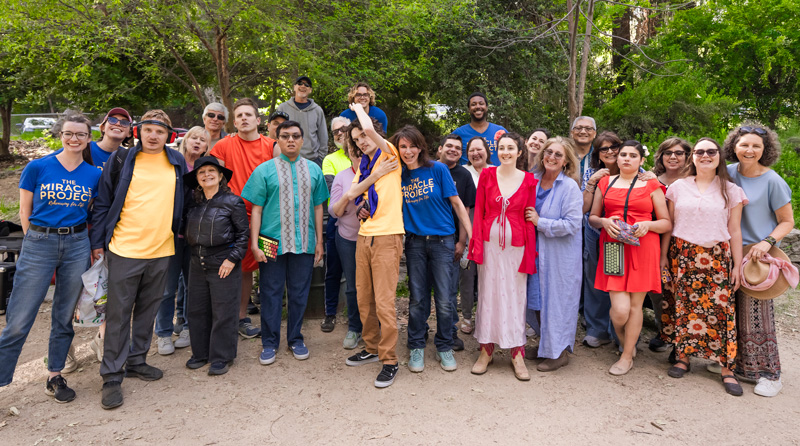
Express Yourself cast members, communication partners, and The Miracle Project creative team gather after filming Unmuted, celebrating the culmination of months of collaborative songwriting, creativity, and multimodal communication.
Only months after planning began, the COVID-19 pandemic forced TMP to move all programming online. Initially viewed as a temporary adjustment, the virtual format became an unexpected strength. The online environment removed geographic barriers, allowing artists from across the country to collaborate. More importantly, it fundamentally changed the pace of the creative process. Traditional theater often rewards quick responses. Express Yourself intentionally does not. Participants have time to think, type, revise, plan motor movements, and build upon one another’s ideas. Rather than emphasizing speed, the process values reflection and depth of thought. Screen sharing, chat functions, visual supports, prerecorded media, and other digital tools became integral artistic resources. When in-person programming resumed, Express Yourself remained online because the virtual environment supported collaboration in ways the team had never anticipated.
Today the program continues to evolve under the leadership of Program Director and Clinical Supervisor Hannah Olander, LCSW, alongside Lead Teaching Artist Shelley Pack and Music Director Mina Bloom, who continually refine the curriculum in response to participants’ interests, communication styles, and creative ideas.
Express Yourself develops entirely original works. Every project begins with the participants themselves: a typed sentence, a poem, a question, an experience someone wants others to understand. These contributions are collected, revisited, and expanded until individual ideas become collaborative works of art. Participants’ reflections become song lyrics, musical styles, imagery, and choreography. Each new perspective redirects the script. Over weeks and months, ideas evolve into artistic works that no individual could have created alone. Instructors function as creative facilitators, identifying emerging themes and encouraging collaboration to help shape participants’ ideas into original songs without speaking for them.
Participant Emma Cladis reflected: “Since starting the Express Yourself program, I have grown as an artist mainly because of the great coaching and support I have been given. I’m so proud of all the other typers. The collaborative work with everyone was the best. We brought out each other’s creative strengths. I think we loved doing this so much, and it shows what is possible.”
Music Director Mina Bloom: “Even when we showed the earliest projects and the quality of the videos was different, the writing, the lyrics, the thoughts they had were just as profound from day one. It’s amazing to see their artistry get the professional quality it deserves.”
As participants continued creating original songs, music videos became a natural fit to reflect the collaborative process itself. Songs could develop gradually through typing, conversation, revision, and shared authorship. Participants returned to projects repeatedly as ideas deepened and evolved, expanding opportunities for artistic expression. Typed text became on-screen graphics. AAC-generated speech and participants’ own voices became part of the soundtrack. Movement, choreography, cinematography, editing, costumes, and visual imagery all contributed to the storytelling. Rather than asking participants to adapt to traditional performance formats, the videos honored the multimodal creative process that had generated them.
Express Yourself participants have created 12 original films. Ten were conceived, written, rehearsed, filmed, and produced entirely through virtual collaboration. Two — Let My Typin’ Let You See and Unmuted — culminated in live video shoots after months of online collaboration. Together these films have been screened at conferences, universities, film festivals, educational events, and community programs, allowing participants’ work to reach audiences well beyond the classroom.
Participant William Del Rosario described the filming experience: “Watching the team doing the scenes felt magical because first, we were on location filming in person, and second, we weren’t looked at as people with disabilities or limits. Instead, we were the stars in our music video and part of the team.”
Participant Antonietta Nelli shared: “Making music videos allows me to keep speaking boldly. I love the creative process and doing this with people I admire.”
Teaching artist Shelley Pack observed: “Creators are creators. This is a really deserving group of talented people who have often never been given an opportunity to be artists. It just takes a little time and a little understanding. That’s why I love The Miracle Project because that’s the place where we create that environment.”
Express Yourself did not teach us that multimodality communicators are artists — we began because we already believed they were. More than six years later, Express Yourself continues to evolve, demonstrating that when environments adapt to participants rather than expecting participants to adapt to the environments, creativity, authentic self-expression, and meaningful connection flourish.
In the words of participant Bella Santoyo:
I found the Miracle Project during the pandemic. It was not a good time for the world, but it gave my community an opportunity to band together via Zoom. My introduction to Expressive Arts with the Miracle Project placed new demands on my mind and body but in a needed and positive way. Each week from the comfort of my home I practiced moving my body in new and organized ways. Each of my friends shared thoughts and affirmations that would become lyrics to songs. We all had visions of how we wanted to bring our collaborative efforts to life. I loved the creative time my friends and I spent together. For me, my involvement filled a void that I didn’t know existed.
Magical is a perfect description of the filming experience. It is still a highlight in my memories. I loved every bit of it, but what stands out most was the day we recorded our voices. I have had the ability to use text-based communication for years. My communication partner or my iPad would speak my words. Still, some have questioned and doubted my intellect. I am proud that I was able to voice my words aloud for myself on that day of filming. I can do many things with the right teaching and patient support. That is a needed takeaway message from our song.
I want to continue to make videos for many reasons. It’s a fun and creative outlet, it challenges me to try new things, but most importantly, I am seen. We break the stigma about disability and autism. We show what is possible when we are given a safe and creative space to express ourselves. Alone is a lonely existence but together we can do great things.
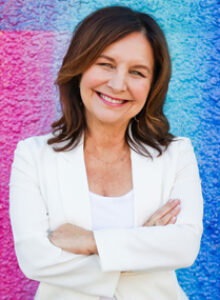
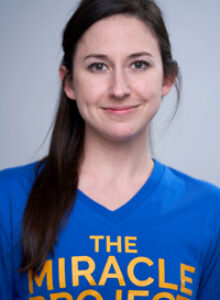
Elaine Hall is Founder of The Miracle Project. Hannah Olander, LCSW, is Program Director and Clinical Supervisor at The Miracle Project. For more information, contact [email protected] or 213-793-5481, or visit themiracleproject.org.
References
Kim, A., Stembridge, S., Lawrence, C., Torres, V., Miodrag, N., Lee, J., & Boyns, D. (2015). Neurodiversity on the stage: The effects of inclusive theatre on youth with autism. International Journal of Education and Social Science, 2(9), 27–39.