
I stop and think about what I went through as a young child all the time. On a scale of 0 to 10, so many of the therapies that overtook my life would get a negative number! It wasn’t that the therapists were bad people; it was because the initial premise of the treatments was fatally flawed. How? I might not have been able to talk, but I knew hundreds if not thousands of words. Pretty silly to assume that just because someone can’t say something, they don’t know it. How else? I observe the world differently, listen differently, and remember differently than others do. There is the belief that anyone who observes, listens, and remembers like me actually isn’t able to learn anything from the world around us. Lots of therapies expect to have to teach patients like me literally everything we’ll know—that we are just empty shells. And how else? The most popular explanations for my lack of eye contact, not to mention my lack of pointing, get it all wrong! Physical challenges are read as emotional distance (“he’s not making eye contact because he doesn’t connect with others”) or not trying hard enough (“he’s not pointing because he’s being stubborn”). So even though almost all of my early instruction required my looking and pointing, no one ever taught me how to look or point!
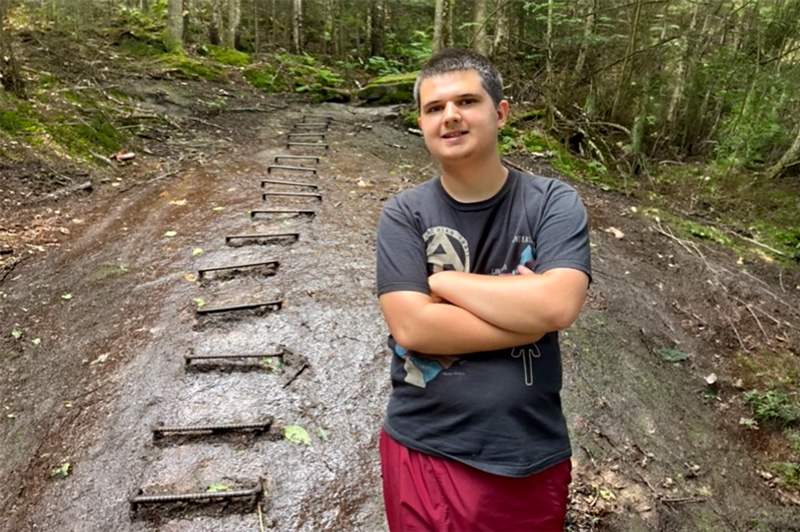
Jace Pooley hiking the Appalachian Trail
Now think about what all those hours of therapy could have looked like with a different mindset. I’ll start with how we might reduce the focus on talking and replace it with a focus on communication, and not just the labeling of a few items but the power to share anything. I took actually communicating into my own hands, literally, by grabbing a pencil to write my thoughts. This took lots of people by surprise, like those trying in vain to teach me to talk and those laboriously trying to get me to point to vocabulary words (and assuming that the vocabulary words were the hard part when the pointing was). Communication doesn’t have to mean speaking, and it also shouldn’t be limited to pathetically few picture cards to point to. The goal has to be getting to use the alphabet, whether with a pencil or letterboard or keyboard.
This requires addressing multiple misconceptions: replacing gross underestimations of what nonspeakers know with presuming competence, and fully appreciating the physical challenges nonspeakers face. If you’re not familiar with “presuming competence,” definitely follow this closely, write this down, and post it somewhere you’ll see every single day. Presuming competence means you give someone the chance to show you their intelligence and empathy and humor because you believe that they are capable in all of those ways. The default expectation is actually that they can think through any demand or question. And that’s true even if responding is physically taxing, and their body behaves differently than yours or needs extra coaching. Keep in mind that our bodies may be struggling even as our brains get immediately to the right answer. This is why motor planning support is so important!
Going forward, how about we prioritize a few things for nonspeakers? Let’s presume competence for sure. If we do, probably lots more people will go to greater lengths to help nonspeakers pursue their goals, grow their confidence, build relationships, and find their voice. Presuming competence means doing things like reading literature or school textbooks out loud, holding real conversations that are age appropriate (even if nonspeakers can’t respond), and meaningfully involving nonspeakers in whatever is going on. Life is pretty lousy when you’re left out, constantly underestimated, given nothing interesting to do, and made to feel like the future will be just as bleak as the present. Our lives get so much richer when the outside world realizes our humanity and feeds it. That lets us connect with others and do the hard work of finding our voice.
By now I hope I’ve got you thinking! Too often, we get in a rut because we stop challenging our perceptions and implicit biases. Knowing this, I’m reminding you to prioritize challenging them, deliberately focusing on how you might be misperceiving the nonspeakers in your life. I’m making a prediction right now that, when you do, there’s something you’ll change. I’m thrilled to think about what those changes are going to mean for you and the nonspeakers you know!
Let me tell you what those changes meant for me and my family. As soon as I began writing, people pivoted from treating me like a baby or problem to solve to treating me like any other elementary school student who loved math and oceanography. My time in school shifted to a focus on grade-level work. Possibly best of all, the obsession with “fixing” me disappeared and was replaced by a new obsession to help me thrive. How incredible!
I’ve since learned to type, and now plan to use my voice to advocate for fellow nonspeakers. I’m hoping you will help by presuming competence and recognizing the humanity of nonspeakers. Help me, too, by considering how absolutely powerful the ability to communicate is. The clearest illustration of just how powerful? Think about how much relationships in your life have been changed or strained by things left unsaid. To not share your hopes and dreams and interests and feelings, particularly how you feel about the people in your life, means creating distance between yourself and others. It means that others don’t get to know the real you. Now think about what those relationships would look like if you’d never said anything at all. To leave all unsaid, as you can imagine, causes real harm. No one should have to suffer like that!
How so many people end up suffering exactly like that is just devastating. My last request of you is to consider that. The best way to reduce this harm is to ensure that everyone has the right to communicate. That takes presuming competence and letting nonspeakers learn the skills they need to use a letterboard or keyboard. Help teach nonspeakers to control their eyes and to point, and help them be calm and confident. Starting now, we’re giving everyone a voice!
To contact Jace Pooley, email [email protected].



I love the way you explain and express yourself Jace. You are an amazing person who has accomplished so much already! I am so proud of you! Keep being yourself and doing amazing things!