Speech pathologists and behavior analysts each bring distinct expertise, yet their greatest impact is realized through integrated service delivery. Separately, these two provider groups apply principles unique to their respective science and discipline, but it is together, with support from collaborative leadership, that these disciplines offer robust capacity for overlap and enhancement of common goals. Both disciplines apply evidence-based therapeutic approaches; both commit to ethical practices; both take pride in their ability to build meaningful skills and improve client quality of life. Common practice settings, including schools, center-based care, and home therapies, present opportunities for collaboration. And organizations, such as Autism Care Partners (ACP), find that offering multiple services in tandem, including speech therapy and applied behavior analysis (ABA), supports their mission, vision, and values of integrated and person-centered care.
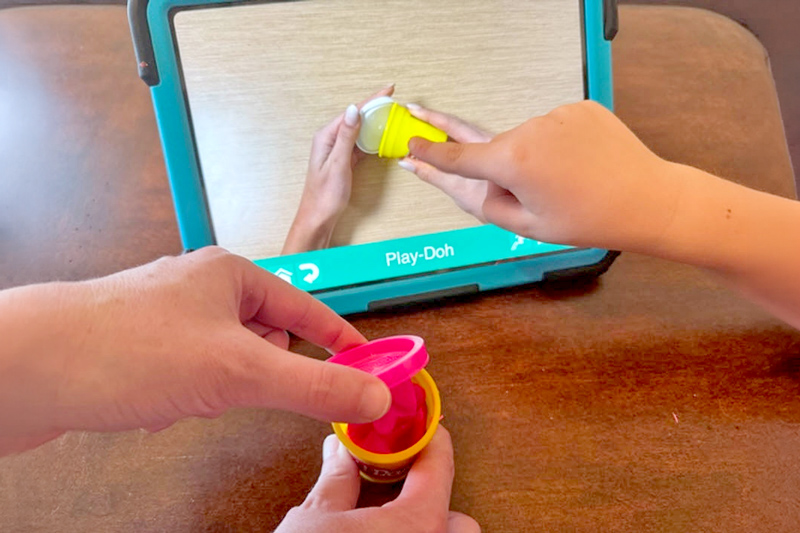
Example of a visual scene display being used to communicate “Open the Play-Doh”
ACP has taken the interdisciplinary approach a step further by partnering with Little Finch to use the Visual Immersion System (VIS)™, an exclusively licensed framework applicable across disciplines and settings. This framework is designed to immerse learners in visuals for instruction, organization, and expression, using tools that meet each learner’s unique needs, and was developed at Boston Children’s Hospital through the work of Dr. Howard Shane. Dr. Shane likes to contextualize the VIS by comparing it to the need for language modifications for individuals who are Deaf. When a learner is Deaf, sign language would be used to meet their language needs. Similarly, we want to immerse our learners in a language most appropriate for them — and there is substantial evidence to indicate the language we use should be a visual one. With VIS, teams can assess each learner’s language development and then apply specific types of visual tools to meet their needs and improve their language.
In ACP’s collaborative setting, both speech pathologists and behavior analysts observe that learners with severe language deficits have difficulty understanding verbs (like “open,” “go,” and “sit”), adjectives (like “empty,” “different,” and “hot”), and prepositions (like “in,” “out,” and “under”). In contrast, nouns — like “door” or “Play-Doh” — are often easier. This is not a rare observation; however, it is within a shared framework that providers can collaborate and problem-solve to address these observations, capitalizing on their individual skillsets to develop successful programming based on available research.
Did you know that some research indicates that an augmentative and alternative communication (AAC) display called a visual scene display (VSD) aligns better with young children’s ability to process information by showing people, actions, and events in context (Light, Wilkinson, Thiessen, Beukelman, & Fager, 2019)? Did you know that early learners respond better to photographs than to abstract visual representations (Simcock & DeLoache, 2006)? Or that short videos and photographs can be used to improve accuracy in following directions (Allen, Shane, Schlosser, & Haynes, 2021; Remner, Baker, Karter, Kearns, & Shane, 2016; Schlosser et al., 2013)? There is a considerable amount of research that supports the use of visuals to improve the joint process of communication; however, considering all elements of that research without a comprehensive perspective is where implementation can break down, especially when looking through the individual lenses of distinct disciplines. For many learners, it is especially important to understand that communication is a two-way process. We need to consider diverse ways to use visuals to clarify our own communication and to help our learners communicate — this applies to both ABA and to speech therapy.
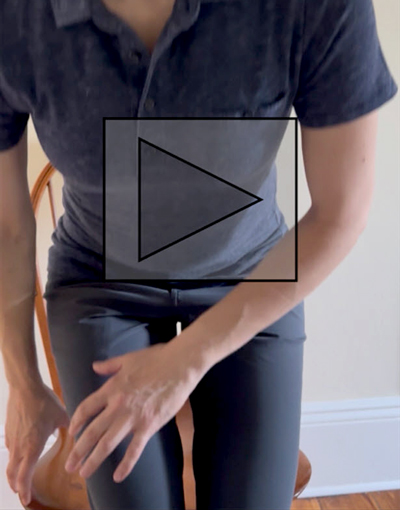
Video depicting the direction “Sit down,” that uses the learner’s exact chair from her home
When using visuals for our own communication, it means providers may not rely solely on verbal directions or physical guidance. The field of ABA has long utilized prompting and prompt-fading to help learners acquire new skills while working toward independence. The goal in ABA is always to provide just the right amount of support needed, and to gradually reduce help as the learner becomes more confident and successful (often referred to as “least intrusive prompting”). Therefore, when a VIS tool is introduced that helps meet this goal and serves as a language aid, it allows alignment between speech pathologists and behavior analysts. Let’s take Grace for example. Grace is working on learning to follow the direction “sit down.” When Grace was given the instruction “sit down” vocally, she was not consistently following the direction. But when the verbal instruction was paired with a video of the action, Grace sat down correctly every time. From a language perspective, the verbal directive of “sit” combined with a preposition (i.e., “down”) can be difficult; however, it can be made easier with the appropriate tool. From the perspective of the behavior analyst, the video serves as a less intrusive means of support for the learner. With VIS, both behavior analysts and speech pathologists can use their individual areas of expertise to enhance learning.
In addition to aiding in comprehension, visuals can offer different ways for our learners to communicate. For example, consider Johnny, who loves to play with Play-Doh. Johnny has been taught to request Play-Doh by saying the word, “Play-Doh.” What happens if Johnny needs help opening the Play-Doh container, but the word “open” is not easy for him to use? Going back to the observations before, verbs such as “open” may be difficult; therefore, Johnny may continue to state “Play-Doh” though he is attempting to communicate the need to open it. By using a visual scene display to represent “Open Play-Doh,” Johnny can communicate not only that he wants Play-Doh (i.e., the noun), but also what action (i.e., “open”) he wants completed with that Play-Doh. From the lens of a behavior analyst, this provides greater choice, more precise communication, and increased control over his environment; from the lens of a speech pathologist, it also provides the opportunity for Johnny to communicate a new word combination (i.e., open+Play-Doh) in a way that matches his understanding of language.
Within these examples, both Grace and Johnny had unique language needs that could be addressed with evidence-based tools; however, communication and language have an impact across all disciplines. As team members collaborate, the shared VIS framework offers guidance for using research to support communication, learning, and independence across settings. Whether the goal is helping a learner understand language, express wants and needs, follow directions, or engage more fully in daily activities, behavior analysts and speech pathologists play a vital role in making communication more accessible. Through a collaborative, learner-centered approach and a common framework, each discipline can better facilitate meaningful experiences that empower learners throughout their day. When learners understand what is expected of them, what is coming next, and how they can communicate their needs, they are often more confident and engaged in the learning process.



Amanda Doran, MEd, BCBA, LABA, is Senior Clinical Director, and Elizabeth Bland, MA, BCBA, is Director of Training and Quality, both at Autism Care Partners; they can be reached at [email protected] and [email protected], respectively, or visit www.autismcarepartners.com. Kara Morrison-Smith, MS, CCC-SLP, ASDCS, is Director of Enablement at Little Finch and can be reached at [email protected] or visit www.littlefinch.org.
References
Allen, A., Shane, H., Schlosser, R., & Haynes, C. (2021). The effect of cue type on directive-following in children with moderate to severe autism spectrum disorder, Augmentative and Alternative Communication, doi:10.1080/07434618.2021.1930154
Light, J., Wilkinson, K., Thiessen, A., Beukelman, D., & Fager, S. (2019). Designing effective AAC displays for individuals with developmental or acquired disabilities: State of the science and future research directions, Augmentative and Alternative Communication, 35:1, 42-55, DOI: 10.1080/07434618.2018.1558283
Remner, R., Baker, M., Karter, C., Kearns, K., & Shane, H. C. (2016). Use of augmented input to improve understanding of spoken directives by children with moderate to severe autism spectrum disorder. eHEARSAY, Journal of the Ohio Speech Language Hearing Association, 6(3), 4-10.
Schlosser, R. W., Laubscher, E., Sorce, J., Koul, R., Flynn, S., Hotz, L., & Shane, H. (2013). Implementing directives that involve prepositions with children with autism: A comparison of spoken cues with two types of augmented input. Augmentative and Alternative Communication, 29, 132–145. doi:10.3109/07434618.2013.784928
Simcock, G., & DeLoache, J. (2006). Get the picture? The effects of iconicity on toddlers’ reenactment from picture books. Developmental Psychology, 42(6), 1352–1357. https://doi.org/10.1037/0012-1649.42.6.1352