I have watched my adult nonspeaking, autistic son be offered a letterboard by someone untrained in his primary form of communication: spelling. His thoughts were clear, but the board wasn’t properly placed, no relationship had been established, no motor coaching was provided — and nothing came through. I have also watched what happens when his Communication Partner is well-trained: the letterboard lands in the same position every time, the energy is calm and supportive, the prompts are motor-based. My son begins to spell. The difference between those two moments is not my son. It is the training — or absence of it — in his Communication Partner.
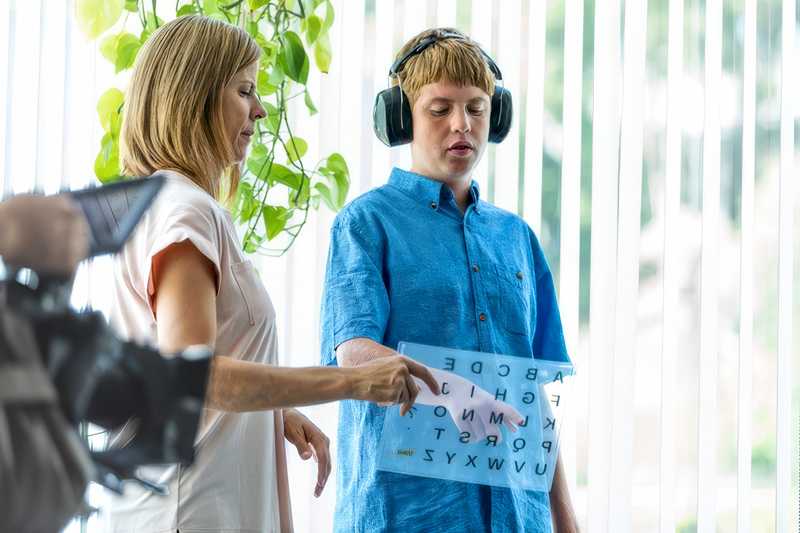
Dawnmarie serving as a communication partner for her son, Evan, during the filming of the movie SPELLERS (now on YouTube)
A Communication Partner, as defined in the augmentative and alternative communication (AAC) literature, is any person – teacher, parent, paraprofessional, therapist, or peer – who regularly interacts with a nonspeaking individual and whose behavior directly shapes the quality of that interaction (Kent-Walsh & McNaughton, 2005).9 In spelling-based AAC, the CP’s role extends well beyond conversation: they position and present the letterboard or keyboard, provide motor coaching through a structured prompting hierarchy, read the speller’s regulatory state, and create the physical and relational conditions under which intentional communication can occur.
Unlike systems where a device carries the message independently, spelling-based AAC is a relational act – and that relational quality, while its greatest strength, also introduces a variable that demands rigorous attention: the potential influence of the partner. Influence is actually present in all communication; Kent-Walsh and McNaughton (2005) describe it as inherent to every human interaction.9 The difference for spelling CPs is consequence: when influence flows from CP to speller during open communication, it doesn’t color the message – it replaces it. Learning to recognize and actively counter that risk is a distinct, trainable competency.
The AAC literature has long documented what untrained partners actually do: they dominate interactions, ask predominantly yes/no questions, interrupt, and provide few opportunities for the AAC user to initiate or respond (Kent-Walsh & McNaughton, 2005).9 When the CP is the variable that determines whether a nonspeaking person can communicate at all, CP training is no longer a professional development option – it is an access issue with a legal framework. Under Title II of the ADA, public entities must ensure that communications with individuals with disabilities are as effective as communications with others. Under IDEA, students are entitled to a free and appropriate public education in the least restrictive environment – a guarantee that is hollow without access to their communication system. A trained CP is not a supplemental service. It is the infrastructure that makes those rights real.1,2 This article describes what that infrastructure looks like – and what it takes to build it.
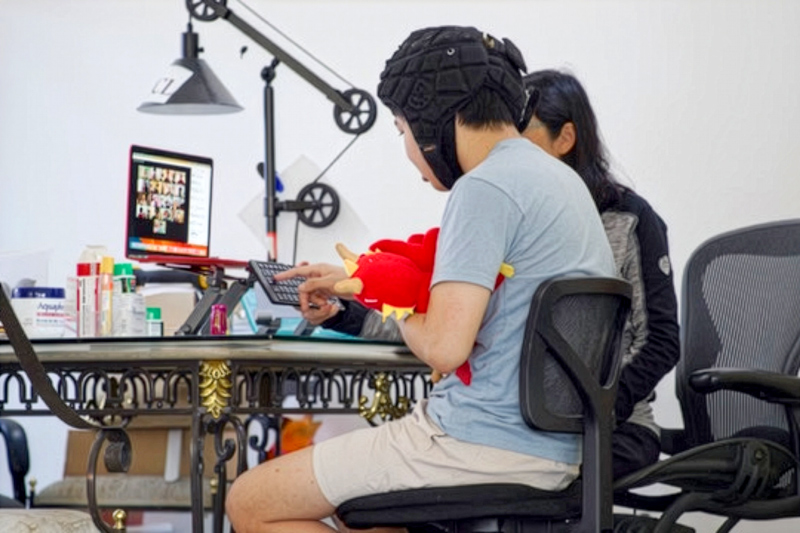
JT, a minimal speaker, typing with his mom, Carol, as his CP. Here he is attending a weekly online social club with his spelling peers.
The Sensorimotor Foundation
The single most important concept a CP must grasp is that not being able to speak is a motor disability, not a cognitive one. This condition is most often called apraxia or dyspraxia – both derived from the Greek root praxis, meaning purposeful, skilled action: the ability to encode, plan, and execute skilled movements.3 In the nonspeaking autistic population, difficulty with praxis can be profound, affecting initiation, execution, inhibition, and sequencing. As Biklen (2005) articulates, “the problem is not one of understanding, but of doing.”4 A student who cannot self-initiate getting their letterboard is not refusing to communicate. They are experiencing a neurological gap between intention and execution.
Dr. Elizabeth Torres, Professor of Cognitive Science at Rutgers, has documented “noise” in the peripheral sensorimotor systems of autistic individuals – stochastic variability in micro-movements differing significantly from neurotypical patterns. Brincker and Torres (2013) found that this peripheral noise impedes central coordination and autonomous control, disrupting the clean execution of intentional motor movement.5 The regulation partner is the external stabilizing force that reduces that noise enough to allow purposeful, directed movement toward a letter.
Torres’s research further identifies the partner relationship itself – their physical proximity, the quality of their presence, the steadiness of their own nervous system – as a variable in the speller’s sensorimotor output.6 Dr. Mona Delahooke, a pediatric psychologist and author of Beyond Behaviors (2019) and Brain-Body Parenting (2022), argues that what looks like behavioral noncompliance is almost always a nervous system signal – a stress response, not a volitional act.7 This is why the CP’s first job is not to present the letterboard; it is to help create the conditions under which the speller’s nervous system can settle enough to access intentional motor movement. Delahooke is explicit that adults must regulate their own nervous systems before they can co-regulate someone else.7

Dawnmarie serving as a communication partner for Max, a non-speaker with Down Syndrome.
The Critical Distinction: Skill Acquisition vs. Open Communication
Understanding co-regulation also exposes the most consequential and most correctable error in CP practice: inadvertent influence during open communication. Preventing it requires a distinction many programs skip – the difference between skill acquisition and open communication.
During skill acquisition, the CP will know the answer. The question is structured: “Whom are we discussing in today’s lesson?” If the answer is Ben Franklin, both CP and speller know it. In this context, certain forms of coaching are appropriate – verbal directional prompts toward the target letter, confirming a selection while not calling out occasional typos, redirecting a motor impulse. This is scaffolded motor learning, bounded by the fact that the CP knows what the correct response should be.
Open communication is categorically different. The speller is generating original thought. The CP does not – and must not – know what will be spelled. Trained CPs must recognize and eliminate these behaviors during open communication:
- Moving the board during spelling. A subtle shift toward a likely next letter provides motor scaffolding the speller did not request. The board must remain still unless the speller has completely shifted their body position, in which case the CP should lift the board and reset it – centered in front of the dominant spelling hand.
- Selectively confirming letters. Calling out some letters and not others during an open-ended response is real-time co-authorship. Confirmation must be consistent and non-selective, which means calling out typos as well.
- Gesturing toward a particular area on the board. Any hand movement, gaze shift, or postural lean toward a portion of the board constitutes a cue. CPs learn stillness as a discipline: neutral posture, neutral gaze, neutral breath.
- Completing anticipated words. AAC research shows roughly 200 words account for 80% of all spoken language (Boenisch & Soto, 2015),8 so some output will be predictable. That predictability does not license word completion. Spellers must be coached to finish every word themselves.
- Asking leading questions. “What don’t you like about your teacher?” presupposes a negative answer. “Is there any feedback you’d like me to share with your teacher?” leaves the field open. The difference between eliciting a response and shaping one is trainable.
These are the most common failure modes in CP practice, and they are almost always unintentional. The most important self-reflection question a CP can ask is: Do this speller’s typed words often surprise me? If not, that pattern warrants honest examination. Video feedback review, third-party observation, and reflective supervision are non-negotiable. Research consistently confirms that CP training programs implemented with high fidelity produce meaningfully better outcomes than isolated or one-time training (Kent-Walsh, Murza, Malani, & Binger, 2015; Douglas et al., 2024).10,11
What Training Must Include
A replicable CP training framework requires three pillars: didactic knowledge (sensorimotor science, apraxia, prompting hierarchies, ethics, influence prevention), competency development (practice with real spellers, video-based feedback, rubric-graded motor task analyses), and ongoing supervision (debrief and coaching from seasoned practitioners). Kent-Walsh and McNaughton (2005) identified an eight-stage instructional model – from baseline assessment through controlled practice, advanced practice in natural environments, and long-term generalization – noting that programs relying on isolated or one-time training consistently fail to produce durable changes in partner behavior.9 This is a professional development process, not a one-time event.
Schools can fund CP training through IDEA funds and state assistive technology grants. Denying a speller access to a trained CP is a denial of communication access under federal law – under Title II of the ADA (28 C.F.R. § 35.160)1 and IDEA (20 U.S.C. § 1400 et seq.).2 The infrastructure exists to fund this work. The obligation exists to provide it.
What’s at Stake
As both a clinician and the parent of two adult spellers, I have watched the world expand for nonspeakers as skilled partners entered their lives — and watched doors close when schools refused to train them. My oldest son spelled out this poem some years ago. I will let his words close this article, because they express what no credential or citation can:
Dormant back in the day, real thoughts get trapped.
No life breath for others to hear them spoken.
The sound in my mind is wasting away, lest a miracle sets it free.
A trusted presence shepherds my thoughts to tangible form.
– Evan Tastor
Communication Partners are not an obstacle, a luxury, or a threat to authentic communication. They are the key that unlocks the door to expressive freedom for nonspeakers.
Dawnmarie Gaivin, RN, ATP, is Executive Director and Co-Founder of Spellers Freedom Foundation. She can be reached at [email protected] or [email protected], and more information is available at www.spellersfreedomfoundation.org. Information about Spellers Method Communication Partner training and certification is available at www.spellers.com.
References
- ADA Title II Regulations, 28 C.F.R. § 35.160. https://www.ecfr.gov/current/title-28/chapter-I/part-35/subpart-E/section-35.160
- IDEA, 20 U.S.C. § 1400 et seq.; U.S. DOE & DOJ. (2014). Effective Communication FAQ. https://www.ed.gov/sites/ed/files/about/offices/list/ocr/docs/dcl-faqs-effective-communication-201411.pdf
- de Marchena, A., Zampella, C. J., Dravis, Z., Pandey, J., Mostofsky, S., & Schultz, R. T. (2023). Measuring dyspraxia in autism using a five-minute praxis exam. Research in Autism Spectrum Disorders, 106, 102200. https://doi.org/10.1016/j.rasd.2023.102200
- Biklen, D. (2005). Autism and the myth of the person alone. NYU Press.
- Brincker, M., & Torres, E. B. (2013). Noise from the periphery in autism. Frontiers in Integrative Neuroscience, 7, 34. https://doi.org/10.3389/fnint.2013.00034
- Torres, E. B., & Donnellan, A. M. (2015). Editorial: Autism: the movement perspective. Frontiers in Integrative Neuroscience, 9, 12. https://doi.org/10.3389/fnint.2015.00012
- Delahooke, M. (2019). Beyond Behaviors. PESI Publishing; Delahooke, M. (2022). Brain-Body Parenting. HarperCollins.
- Boenisch, J., & Soto, G. (2015). The oral core vocabulary of typically developing English-speaking school-aged children: Implications for AAC practice. Augmentative and Alternative Communication, 31(1), 77–84. https://doi.org/10.3109/07434618.2014.1001521
- Kent-Walsh, J., & McNaughton, D. (2005). Communication partner instruction in AAC: Present practices and future directions. Augmentative and Alternative Communication, 21(3), 195–204. https://doi.org/10.1080/07434610400006646
- Kent-Walsh, J., Murza, K. A., Malani, M. D., & Binger, C. (2015). Effects of communication partner instruction on the communication of individuals using AAC: A meta-analysis. Augmentative and Alternative Communication, 31(3), 271–284. https://doi.org/10.3109/07434618.2015.1052153
- Douglas, S. N., Dunkel-Jackson, S. M., Bowles, R., Plavnick, J., Sun, T., & Bagawan, A. (2024). POWR+ intervention results: An online communication partner training program for educational teams. Augmentative and Alternative Communication. https://doi.org/10.1177/15257401241303160