
Play and recreation are where many of the most important parts of human development take shape. Through shared activities, people learn how to connect with others, how to manage differences, how to experience themselves to their fullest abilities, and how to feel part of something larger than themselves. Across the lifespan from infancy through older age, participation in chosen activities supports emotional regulation, problem solving, physical well-being, and social connection. These enjoyable experiences help build identity and a sense of fulfillment that has a lasting impact through various stages of growth.
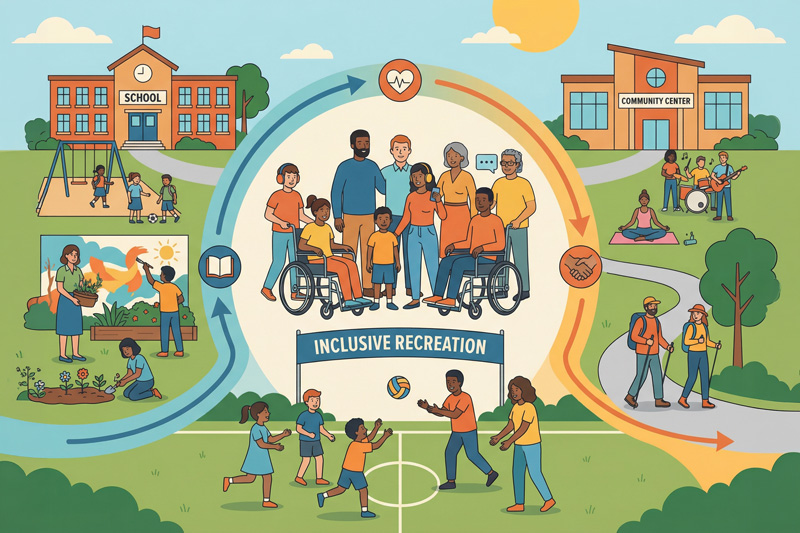
For autistic people and others with disabilities, recreation often carries meaning. It is a context where learning is guided by interest and where communication can take many forms. It is also a place where relationships develop and where people can explore individual preferences, build confidence, and experience participation in ways that are motivating and personally meaningful.
Research in psychology, occupational science, and public health consistently shows that development is strengthened through enjoyable and shared participation. Children learn through active engagement with peers and family members. Adolescents shape identity through personal interests as well as group involvement. Adults support health and purpose through movement and leisure. Older adults maintain well-being through continued community participation and meaningful roles. These patterns reflect how human growth unfolds across the lifespan.
In many educational and community systems, recreation is not always positioned as a core developmental need. It may be scheduled when time allows or organized separately from essential services. For autistic people and others with disabilities, this often limits access to the same opportunities that support connection and growth received by their peers. The challenge usually lies in how activities are structured and how participation is supported.
How staff and programs approach participation shapes who can take part. When activities are set up for only one way of communicating or moving, some people end up watching instead of actively joining along. When routines are rigid and expectations are narrow, differences are seen as problems instead of opportunities for support. When instruction is not adapted, participation drops even when interest and ability are present. Over time, these patterns limit access and make it harder for people to feel that they belong.
For this vision to become everyday practice, training matters. Staff and program leaders need opportunities to learn how to recognize participation barriers, identify ways to work around and how to adapt activities in meaningful ways, and how to support a wide range of communication and movement styles with confidence. When training is grounded in clinical knowledge, lived experience, and real-world application, it gives teams practical tools they can use immediately. It helps move inclusion from intention to action, and from isolated efforts to consistent practice across classrooms, gyms, playgrounds, and community programs. With shared understanding and skilled guidance, inclusive recreation becomes something people know how to do, not something they hope will happen.
Effective training in inclusive recreation needs to be guided by professionals who understand disability and neurodivergence and who work directly in group-based programs. This includes experiences with communication differences, movement needs, and the decisions staff make during activities. Training led by specialists in inclusive recreation and clinical practice helps staff recognize participation barriers early and make appropriate adjustments while keeping programs safe and meaningful for all involved.
Inclusive recreation requires intentional design and skilled facilitation. When staff are trained to notice how each person communicates and how each person moves, they can adjust activities, so participation becomes possible rather than optional. When peers are guided to adapt to their own expectations, group activities become shared rather than remaining separated. For children, this supports social problem-solving and emotional regulation within play. For adults, this supports connection and confidence through meaningful group participation. Over time, these experiences strengthen functional skills and mental well-being, and they build a lasting sense of belonging within community life.
Practical changes in recreation programs often start small. Posting a simple visual and/or written schedule can help students know what is coming next. Keeping routines consistent can make transitions easier and reduce stress. Slightly adjusting a rule, the pace of a game, or how equipment is used can make it possible for more students to remain in the activity with their peers. When activities are broken into clear steps and students are given more than one way to join, participation becomes more natural without changing the true nature and intention of the program. Over time, listening to students and families’ helps staff see what is working and what could be made more available, accessible, and welcoming.
In schools, recreation also aligns closely with educational goals and the intent of the Individuals with Disabilities Education Act. Participation in physical education, recess, clubs, and extracurricular activities supports skills that are central to many IEPs, including social communication, self-regulation, peer interaction, motor planning, and participation in group routines. When recreation is viewed as an IDEA Related Service, it becomes part of how students practice functional skills in natural settings rather than only in isolated instructional time. These experiences allow goals to be addressed through individual and/or group play, movement and shared activity, which often increases motivation and generalization. In this way, recreation supports access to the curriculum, participation in school life, and progress toward meaningful educational outcomes.
Strong connections between schools and community recreation programs further extend these benefits. For afterschool programs and camps, these partnerships help staff understand which supports already help a child take part and how to carry those supports into group activities without changing how the program runs. This creates smoother transitions between school and out-of-school programs and helps children remain with their peers during activities. When districts, municipalities, and local organizations communicate and collaborate, students are more likely to experience continuity between school-based activities and community participation. This supports the spirit of the ADA by promoting access to typical programs rather than relying on separate options. These partnerships can look different depending on setting and resources. Urban communities may draw on large park systems or adaptive sports programs. Suburban areas may partner with local recreation departments or YMCAs. Rural and tribal communities may rely on schools, cultural centers, or shared regional programs. No single organization is expected to meet every need. When each setting contributes within its capacity, and when inclusion is approached as a shared responsibility, participation becomes more consistent, more sustainable, and more reflective of the communities people live in.
This way of building inclusive recreation also strengthens programs over time. When staff learn how to adapt to activities within existing settings, fewer people are pushed into separate programs and more can remain with their peers. Schools and community programs spend less energy creating parallel options and more energy supporting participation in what options already exist. Over time, this leads to more consistent programming, stronger staff skills, and greater trust from families.
Recreation supports connection and contribution. When schools and community organizations recognize it as central to development, they create pathways to belonging that extend across the lifespan. Investment in professional training, clinical guidance, and inclusive program design strengthens participation, deepens relationships, and supports full engagement in community life.


Adrienne Robertiello, ACDS, is Interim Autism Program Coordinator, Specialized Health Care Educator and Caitlyn Foelsch, CTRS, MHA, CHM, is Manager of Community Programs at Children’s Specialized Hospital. For more information, email [email protected] or visit rwjbh.org/childrens-specialized-hospital.
References
Anderson, L., & Heyne, L. (2011). Therapeutic recreation in schools: Supporting children’s social and emotional well-being. Impact: Feature Issue on Supporting the Social Well-Being of Children and Youth with Disabilities, 24(1). Institute on Community Integration, University of Minnesota. https://publications.ici.umn.edu/impact/24-1/therapeutic-recreation-in-schools-supporting-childrens-social-and-emotional-well-being
Ashburner, J., Ziviani, J., & Rodger, S. (2010). Surviving in the mainstream: Capacity of children with autism spectrum disorders to perform academically and regulate their emotions and behavior at school. Research in Autism Spectrum Disorders, 4(1), 18–27. https://doi.org/10.1016/j.rasd.2009.07.002
Block, M. E., Taliaferro, A., Harris, N., & Krause, J. (2010). Using self-efficacy theory to facilitate inclusion in general physical education. Journal of Physical Education, Recreation & Dance, 81(2), 43–46. https://doi.org/10.1080/07303084.2010.10598448
Huang, C.-C., & Kang, L.-J. (2021). Participation in Play and Leisure Activities of Young Children with Autism Spectrum Disorder and Typically Developing Children in Taiwan: A Preliminary Study. International Journal of Environmental Research and Public Health, 18(11), 5787. https://www.mdpi.com/1660-4601/18/11/5787
MacDonald, M., Esposito, P., & Ulrich, D. (2011). The physical activity patterns of children with autism. BMC Research Notes, 4, 422. https://doi.org/10.1186/1756-0500-4-422
Mahoney, J. L., Larson, R. W., Eccles, J. S., & Lord, H. (2005). Organized activities as developmental contexts for children and adolescents. In J. L. Mahoney, R. W. Larson, & J. S. Eccles (Eds.), Organized activities as contexts of development: Extracurricular activities, after-school, and community programs (pp. 3–22). Lawrence Erlbaum Associates. https://doi.org/10.4324/9781410612748
Ratcliff, K., Hong, I., & Hilton, C. (2018). Leisure participation patterns for school age youth with autism spectrum disorders: Findings from the 2016 National Survey of Children’s Health. Journal of Autism and Developmental Disorders, 48(11), 3783–3793. https://doi.org/10.1007/s10803-018-3643-5
Wentzel, K. R., & Caldwell, K. (1997). Friendships, peer acceptance, and group membership: Relations to academic achievement in middle school. Child Development, 68(6), 1198–1209. https://doi.org/10.1111/j.1467-8624.1997.tb01994.x

This is a point well taken. The problem is how my adult son’s group home might carry this out. The OPWDD has limited funds.