Part 1 and part 2 of Wired to Deliver explored two sides of the same coin: (1) why autistic professionals often bring cognitive strengths well suited to project management, and (2) how organizations can create environments where those strengths are recognized and used effectively.
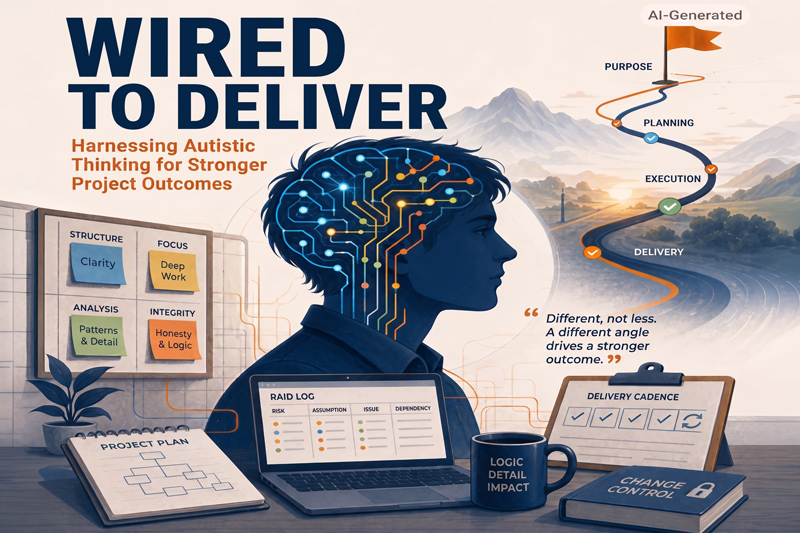
Part 3 asks a different question — the one leaders care about: What happens to project outcomes when autistic PMs are empowered to work the way they work best? The answer is simple: Projects get better. Not because autistic PMs are “better people,” but because their cognitive strengths align with the structural demands of complex delivery. When organizations remove unnecessary barriers, those strengths become visible — and measurable (Adigun et al., 2025; Austin & Pisano, 2017).
Here are five organizational gains that consistently emerge when autistic PMs are supported and allowed to thrive.
1. Earlier Detection of Structural Risks
Many autistic PMs excel at pattern recognition — noticing inconsistencies, dependencies, and failure modes long before they become visible to others. Research on autistic cognition shows enhanced perceptual functioning and hyper‑systemizing, which support early detection of structural risks (Mottron et al., 2006).
When organizations encourage clear communication, written expectations, and structured reporting, those insights surface earlier. Early risk detection is not a personality trait. It is a competitive advantage (Adigun et al., 2025).
2. More Reliable Project Controls
Autistic PMs often bring strengths in diligence, accuracy, and systematic thinking. Studies consistently show that autistic professionals excel in detail‑oriented, structured work environments (Lorenz et al., 2016).
When paired with clear expectations and structured communication, these strengths translate into cleaner schedules, more accurate forecasts, tighter change control, and better requirements validation (Adigun et al., 2025). These are not “soft benefits.” They are the backbone of predictable delivery.
3. Higher Quality Decision‑Making
Autistic PMs tend to reason logically, systematically, and without being overly influenced by social dynamics. Research shows autistic adults often rely more heavily on data and logical reasoning than on social cues (De Vries & Geurts, 2015).
When organizations evaluate performance based on outcomes rather than charisma, autistic PMs can contribute more directly to decision-making. The result is decisions that are less political, more data‑driven, and more aligned with project reality (Austin & Pisano, 2017). In complex environments, clarity beats charisma every time.
4. Stronger Accountability and Follow‑Through
Many autistic professionals excel at sustained focus and commitment to task completion. Studies show that autistic workers often demonstrate high reliability, consistency, and dedication when expectations are explicit (Lorenz et al., 2016).
When organizations provide explicit expectations and eliminate ambiguity, that focus becomes a stabilizing force. Teams benefit from PMs who follow through consistently, maintain structure, keep commitments visible, and ensure decisions turn into action (Adigun et al., 2025). This is the kind of leadership that keeps projects moving.
5. A More Inclusive, More Effective Project Culture
When organizations adopt practices that help autistic PMs thrive — clear expectations, structured communication, outcome‑based evaluation — something interesting happens: Everyone benefits. Research on inclusive workplaces shows that clarity, structure, and predictable communication improve performance for neurotypical employees as well (Shore et al., 2011).
Stakeholders appreciate written decisions. Executives appreciate predictable delivery. Teams appreciate reduced ambiguity.
What begins as inclusion becomes improvement.
The Organizational Insight That Matters
Supporting autistic PMs is not charity. It is not accommodation. It is not “special treatment.” It is good project management. When organizations eliminate unnecessary ambiguity, measure performance by outcomes, provide structured communication, and create multiple paths to leadership, autistic PMs thrive — and so do their projects (Doyle, 2020; Adigun et al., 2025).
The goal is simple: Build environments where every PM can deliver at their best — including those wired to deliver in ways the organization has not yet learned to value. That is the future of project management. And it is well within reach.
Epilogue — Wired to Deliver
Across this three‑part series, one theme has been constant: project management rewards clarity, structure, pattern recognition, and disciplined execution — strengths many autistic professionals naturally bring to complex work (Mottron et al., 2006). But talent alone isn’t enough. Autistic PMs thrive when organizations remove unnecessary ambiguity, communicate with precision, evaluate performance by outcomes rather than personality, and create multiple paths to leadership (Adigun et al., 2025; Austin & Pisano, 2017).
Part 1 explained why autistic cognition aligns so well with project management. Part 2 showed how organizations can build environments where those strengths are recognized and used. Part 3 demonstrated the payoff: earlier risk detection, stronger project controls, clearer decisions, and more reliable delivery.
The lesson is simple: Supporting autistic PMs isn’t accommodation — it’s good project management. When organizations create conditions where every PM can deliver at their best, projects don’t just succeed more often. They succeed more predictably, more intelligently, and with greater resilience. That is what it means to be wired to deliver.
“I think differently — and that difference delivers.” – Unknown

Ronald Smith has over four decades of experience as a Senior PM/Program Manager. He retired from IBM having written four books and over one hundred articles on project management and the systems development life cycle (SDLC). He’s been a member of the Project Management Institute (PMI) since 1998, which has a membership of about 3 million professionals worldwide. From 2011 to 2017, Ronald was an Adjunct Professor for a Master of Science in Technology and taught PM courses at the University of Houston’s College of Technology. Teaching from his own book, Project Management Tools and Techniques – A Practical Guide, Ronald offers a unique perspective on project management that reflects his many years of experience. Besides writing, he swims five times a week to keep in shape. Lastly, in the Houston area, he has started up two Toastmasters clubs and does voluntary work at various food banks to help people facing hunger.
References
Adigun, L., Dacre, N., Pontin, D., Tite, C., & Wilkinson, L. (2025). Promoting Neurodiversity: Unveiling Barriers and Enablers in the Project Management Profession. Association for Project Management.
Austin, R. D., & Pisano, G. P. (2017). Neurodiversity as a competitive advantage. Harvard Business Review.
De Vries, M., & Geurts, H. (2015). Cognitive control and logical reasoning in autism spectrum disorders. Journal of Autism and Developmental Disorders.
Doyle, N. (2020). Neurodiversity at work: A biopsychosocial model and the impact on working adults. British Journal of Occupational Therapy.
Lorenz, T., Frischling, C., Cuadros, R., & Heinitz, K. (2016). Autism and overcoming job barriers: Comparing job‑related barriers and facilitators in autistic and non‑autistic adults. Journal of Vocational Behavior.
Mottron, L., Dawson, M., & Soulières, I. (2006). Enhanced perceptual functioning in autism: An update. Journal of Autism and Developmental Disorders.
Shore, L. M., et al. (2011). Inclusion and diversity in work groups: A review and model for future research. Journal of Management.