
I vividly remember when Annie was diagnosed with autism on Jan. 8, 2004, the day before her second birthday. I had no idea what autism was, other than how it was depicted in the movie “Rain Man,” starring Tom Cruise and Dustin Hoffman. I felt shocked, worried and alone. I didn’t know any other parents who had a child with autism or any other disability. I also had two young sons to care for – a 3-year-old and a newborn. I was overwhelmed. Annie’s doctors told me she had “classic autism.” There also was a condition called Pervasive Developmental Disorder, Not Otherwise Specified (or PDD NOS), and I remember hoping she would be diagnosed with that instead of autism because autism was more “severe,” or so we were told at the time. With “classic autism,” the doctors said if she didn’t speak by the time she was 5 years old, she likely never would.
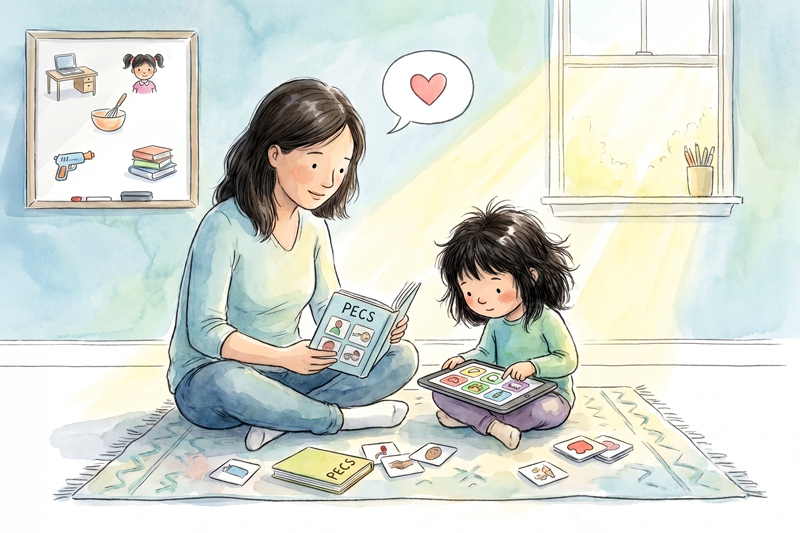
Under the advisement of Annie’s medical and therapeutic team, I created a busy home Applied Behavior Analysis-based program that also included speech, occupational and physical therapy. Annie spent four hours each week in speech therapy, working with a wonderful speech and language pathologist who taught me to see Annie’s strengths. In addition to not speaking, Annie didn’t know how to show us what she wanted or needed without crying, which broke my heart. Eventually, she began to learn the Picture Exchange Communication System (PECS), which uses pictures to create sentence strips, allowing Annie to express what she wanted. She had to learn how to differentiate between pictures and create sentences. That was the beginning of her being able to express her needs.
As Annie grew older, she continued to receive speech therapy, use PECS and attend the Devereux Center for Autism Research and Education Services (CARES), an Approved Private School that helps students with autism and other developmental disabilities build essential communication, social, daily living and job skills. We learned Annie had verbal apraxia, which basically means the part of her brain that controls how to move her mouth and tongue in order for sounds and words to come out was “disconnected” in a sense. Annie was frustrated that she couldn’t make comprehensible words, and I was sad and frustrated for her.
There was a constant focus on speaking in school, in home therapy and in daily life. Annie’s fifth birthday arrived, and she still wasn’t talking. All I could remember was what the doctor told me, “If she doesn’t speak by the time she turns 5, then she probably never will.” We had a small family party, and I arranged Oreos in the shape of a cake since Annie didn’t like cake. There was no candle because Annie couldn’t blow one out because of the verbal apraxia. I cried all day and thought, “My daughter will never talk.” I was heartbroken – for her and for me.
Over the next several months, I mourned the idea that Annie wouldn’t speak and worked on adjusting my perspective. If she couldn’t talk, I had to help her to better communicate her wants and needs so she would not be frustrated at every turn in life. As I slowly moved away from the focus on speech, we saw Annie become more proficient at PECS. She started making sentence strips with word icons and even created sentences to request things that weren’t established words in her PECS book. For example, she put this on her sentence strip: I WANTYOU-ARE-MY-SUNSHINE-SONG CHIPS. She was requesting SunChips when she didn’t even have that word in her book. I was beginning to see just who my little Annie was – a clever young lady who really wanted to communicate!
Over time, Annie continued to communicate with PECS and then advanced to an iPad app called ProLoQuo2Go, which is set up to look like an electronic version of a PECS book. This made it easier to expand her vocabulary as we learned what she needed – and it was more portable. On Annie’s eighth birthday, we celebrated with her first-ever birthday cake, and she learned how to blow out her candle! I noticed she was using her iPad more to look up various things on Google. I examined her scrolling history and saw she was researching Sesame Street characters, different kinds of foods and dental videos. This gave me insight into Annie’s mind. She was interested in so many things she couldn’t “talk” to me about.
I began talking to Annie about these topics. We worked on trying to communicate through her iPad or by writing words down on a whiteboard or in a notebook, with each of us taking turns. She began to spell independently of her PECS, at first through rote memory, and then, with the magic of autocorrect, she figured out how to communicate some of the words she was thinking but didn’t know how to spell. I was amazed. I was getting to know my daughter so well, without her speaking words. Communication was the key, not talking.
Shortly after Annie’s 10th birthday, she said her first words, beginning with “mama,” “want mama” and “no.” Over the years, she started to string a few more words together.
Annie is now 24 years old and still uses her iPad to assist with communication. She also speaks in three to four-word phrases. While the words and phrases aren’t always intelligible to me or others due to the apraxia, she is patient and will repeat or spell them out if I still don’t understand. Annie’s spelling capabilities are so quick and impressive that I often need her to repeat things because I can’t keep up.
Ironically, her favorite phrase to say is, “All done talkin’ ’bout it,” especially when we are discussing topics like chores or activities she doesn’t prefer. What an appropriate response!
I will always be grateful for Annie’s speech and language pathologist and her amazing teachers at Devereux CARES for helping me truly learn who Annie is – and helping her communicate that with the world.
For all those families who have a non-speaking or minimally verbal autistic child or adult, please know this:
- We should never let others – even doctors – place limits on our kids. They can, and will, do so much, but it’s all on their personal timelines, when they are ready, not when we are ready.
- See beyond words. Speech isn’t the key to communication. There are many other ways to communicate, and it’s important to focus on the ways that work for your loved one. That is their strength. Build communication from there, whether it’s through PECS, sign language, a letter board or writing on a whiteboard. Sounds and grunts also can turn into a personal form of language.
- You are not alone. Find other families with a similar situation to yours so you can support each other. Families are by far the very best resource you will encounter.
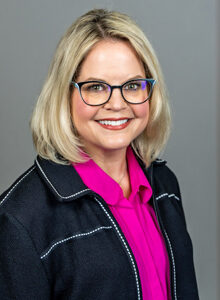
Amy Kelly, MBA, MNM, Devereux’s national director of family engagement, is the mother to Danny, Annie and Ryan. Annie is diagnosed with profound Level 3 autism, intellectual and developmental disabilities, verbal apraxia and general anxiety disorder. Amy serves as a family advisor on several special needs boards in the community, locally and nationally. In addition, she participates with other self-advocates and family partners in efforts supported by the Autism Care Network and serves on an executive committee and the Autism Committee for the American Academy of Pediatrics to assist children and adolescents with neurodiversity needs, advocacy and the importance of quality care.


To all grandmas, and relatives of people like Annie, be generous with your time and help to help your family make progress. It’s SO VERY IMPORTANT! Annie is my granddaughter and we have a very solid relationship. We have a lot of giggles and fun together and moms and dads deserve relief when you fill in as caregiver. It’s a win-win!
This is a very important and helpful article.
This article will give hope and purpose to many families.