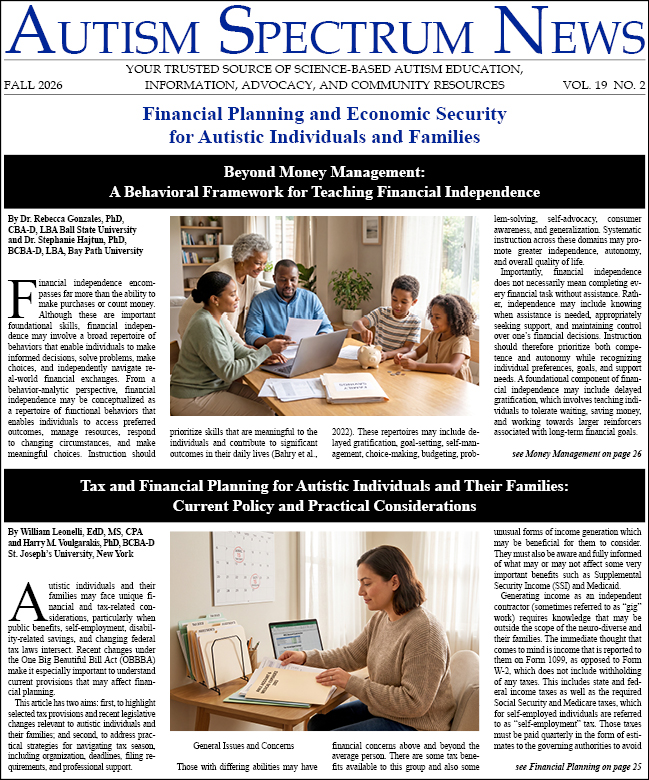
Financial independence encompasses far more than the ability to make purchases or count money. Although these are important foundational skills, financial independence may involve a broad repertoire of behaviors that enable individuals to make informed decisions, solve problems, make choices, and independently navigate real-world financial exchanges. From a behavior-analytic perspective, financial independence may be conceptualized as a repertoire of functional behaviors that enables individuals to access preferred outcomes, manage resources, respond to changing circumstances, and make meaningful choices. Instruction should prioritize skills that are meaningful to the individuals and contribute to significant outcomes in their daily lives (Bahry et al., 2022). These repertoires may include delayed gratification, goal-setting, self-management, choice-making, budgeting, problem-solving, self-advocacy, consumer awareness, and generalization. Systematic instruction across these domains may promote greater independence, autonomy, and overall quality of life.

Importantly, financial independence does not necessarily mean completing every financial task without assistance. Rather, independence may include knowing when assistance is needed, appropriately seeking support, and maintaining control over one’s financial decisions. Instruction should therefore prioritize both competence and autonomy while recognizing individual preferences, goals, and support needs. A foundational component of financial independence may include delayed gratification, which involves teaching individuals to tolerate waiting, saving money, and working towards larger reinforcers associated with long-term financial goals. When targeting long-term purchases, such as buying a new coat, saving for a vehicle, or preparing to move into a first apartment, it is important to develop the skills necessary to save consistently and consider the relationship between short-term purchases and long-term financial goals. Instruction in delayed gratification emphasizes postponing short-term spending when doing so is consistent with the individual’s preferences and goals. For example, an individual may practice saving for a new pair of shoes or tickets to a preferred event, therefore learning that saving can support access to larger, meaningful outcomes.
Building on these financial goals, goal setting may further strengthen financial independence by teaching individuals to develop simple, achievable goals that gradually increase in complexity. Short-term goals should focus on small, attainable criteria before progressing to more advanced financial objectives. For example, a short-term goal may involve independently using a debit card to purchase a preferred drink at a familiar store. Once mastered, this goal can expand to purchasing items in multiple locations using novel payment methods. Long-term goals may require sustained savings over months or years, preparing individuals to engage in increasingly complex financial tasks.
As individuals begin to develop and work toward financial goals, self-management becomes essential for organizing and carrying out the behaviors required to meet those goals. Self-management encompasses a range of skills that support independent financial behavior, including the use of checklists, visual supports, and organizational systems to guide purchasing and budgeting for activities. These skills may involve creating and following a grocery list, identifying items needed for meal preparation, or using a visual checklist to determine what must be purchased when moving into a new home.
For example, an individual will:
- locate a recipe online,
- identify which ingredients are available and which are needed,
- generate a checklist of required items,
- purchase those items, and
- follow the recipe to prepare the meal.
This example demonstrates that financial independence often involves coordinated behavior chains rather than isolated money-management skills. Self-management also extends to overseeing one’s bank accounts, establishing checking and savings accounts, and managing spending and saving to meet daily needs and preferred activities. Effective self-management may support greater autonomy and promote consistent, organized financial decision-making.
Before implementing instruction, it can be helpful to identify which financial skills an individual already performs independently, and which skills may require additional support. Families and individuals can consider skills such as making purchasing decisions, using different payment methods, following a budget, navigating stores, managing online purchases, monitoring accounts, asking for assistance, and responding to unexpected financial situations. It is also important to consider whether the skill can be performed independently across different people, places, and situations. For example, an individual may be independently able to use a debit card at a familiar store, but need additional practice using cash, purchasing from an unfamiliar store, or completing a transaction with a different employee. Identifying current strengths and areas for growth can help families prioritize meaningful goals and build financial independence gradually.
As individuals gain competence in managing their own financial behavior, instruction must also address safe and effective participation in both online and in-person shopping. These skills include navigating online stores, comparing prices, reviewing product descriptions, identifying secure payment options, and completing digital purchases independently. Instruction should emphasize purchasing items from reputable or certified sellers and recognizing indicators of fraud to avoid accidental scams and financial loss. Developing these online shopping skills may support safer consumer behavior and reduce monetary risk during purchasing activities.
Financial independence further requires the ability to manage money in community settings. This includes navigating financial exchanges at restaurants, such as ordering independently, reviewing prices, calculating totals, determining appropriate tip amounts, and completing payment using various methods, all while selecting menu items within a predetermined budget and making cost-aligned choices. Individuals must also learn to manage transportation-related expenses, including budgeting for bus, train, rideshare, or taxi fares; comparing prices across transportation options; and making cost-effective decisions for community travel. In addition, individuals may benefit from learning to manage their money through a bank, including depositing and withdrawing funds, monitoring account balances, using online banking tools, and making informed decisions about saving and spending. Together, these community-based financial skills support greater autonomy and prepare individuals to navigate a wide range of real-world financial demands.
To support these increasingly complex financial behaviors, additional skills such as choice-making, following budgets, problem-solving, and self-advocacy become essential. Choice-making involves selecting among different stores, brands, or shopping activities, as well as choosing preferred payment methods such as cash or a debit card. Providing choices during instruction may also support engagement for some learners (Peterson et al., 2016). Following budgets and spending plans requires tracking expenditures, allocating funds appropriately, and adhering to a structured budget. Individuals may benefit from apps or free online tools that support planning for specific items or long-term goals, monitoring spending patterns, and identifying areas where expenses can be reduced.
Problem-solving includes navigating financial challenges, such as paying with cash or resolving difficulties at the register, often taught through modeling and roleplaying in various purchasing scenarios. Self-advocacy may include expressing preferences for items, brands, stores, or shopping environments, thereby promoting autonomy and strengthening financial decision-making. Consumer awareness includes attending to one’s surroundings and following social expectations in community settings, such as remaining in line, navigating aisles safely, adjusting proximity when others pass with carts, and using polite phrases like “excuse me” when reaching for items.
Financial independence also requires the ability to recognize when support is needed. For example, an individual may independently complete routine purchases but seek assistance when a bank account contains unfamiliar charges, a cashier provides an unexpected total, or an online seller requests unusual financial information. Teaching individuals to appropriately seek assistance should therefore be considered a component of independence rather than a failure to demonstrate independence.
As these skills develop, generalization may become a critical priority. Individuals must be able to apply financial skills across settings, people, and situations. If an individual learns only one payment method, such as using a card, they must be able to confidently transition to alternatives, such as cash, when needed. Instruction should therefore include practicing multiple payment modalities (e.g., card, Apple Pay, cash) across varied purchasing contexts to ensure generalization of skills. Learners should also practice interacting with novel individuals, including greeting store employees and responding to common questions during purchases. Additionally, generalizing purchasing skills to online environments and understanding how online transactions differ from in-person exchanges is an essential part of comprehensive financial training. Multiple examples, varied practice opportunities, prompting and fading, and practice across settings and people can also be used to promote generalization.
To support the acquisition and generalization of these skills, families, educators, and practitioners can use structured, evidence-based instructional methods. Behavioral Skills Training (BST) provides one such systematic approach for introducing, modeling, and practicing new financial behaviors. BST consists of four components: instruction, modeling, rehearsal, and performance feedback (Parsons et al., 2012). For example, when teaching purchasing skills, the trainer may provide written and verbal instructions outlining each step of the transaction, model the steps using relevant payment methods, engage the learner in role-play with the trainer acting as the store employee, and deliver performance feedback to strengthen accurate responding. This structured sequence ensures learners acquire, practice, and refine financial skills in a manner that promotes fluency, confidence, and generalization across real-world contexts.
Ultimately, financial independence may be viewed as a behavioral repertoire rather than a single skill. Effective instruction extends beyond teaching individuals to count money or complete purchases and instead addresses the broader behaviors required to make informed choices, manage resources, solve problems, advocate for preferences, recognize financial risks, and appropriately seek assistance. By systematically assessing and teaching these skills while programming for generalization, individuals can support meaningful increases in autonomy, independence, and quality of life.


Dr. Rebecca Gonzales, PhD, BCBA-D, LBA, is Assistant Professor at Ball State University. Dr. Stephanie Hajtun, PhD, BCBA-D, LBA, is Adjunct Professor at Bay Path University. For more information, email Dr. Gonzales at [email protected].
References
Bahry, S., Gerhardt, P. F., Weiss, M. J., Leaf, J. B., Putnam, R. F., & Bondy, A. (2022). The ethics of actually helping people: Targeting skill acquisition goals that promote meaningful outcomes for individuals with autism spectrum disorder. Behavior Analysis in Practice, 16(3), 672–695. https://doi.org/10.1007/s40617-022-00757-x
Parsons, M. B., Rollyson, J. H., & Reid, D. H. (2012). Evidence-based staff training: A guide for practitioners. Behavior Analysis in Practice, 5(2), 2–11. https://doi.org/10.1007/BF03391819
Peterson, C., Lerman, D. C., & Nissen, M. A. (2016). Reinforcer choice as an antecedent versus consequence. Journal of Applied Behavior Analysis, 49(2), 286–293. https://doi.org/10.1002/jaba.284