I got used to being silent. It was the loneliness and being invisible that was soul crushing. Being able to finally say anything I wanted as a nonspeaking autistic with apraxia was liberating.
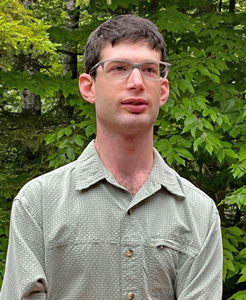
Ben Crimm
I have never been able to communicate by using my mouth. When I was a child, I did speak a few words and some highly practiced phrases. I could also sing the words to many simple songs. But I could never speak to do the reciprocal exchanges that we call conversation. I could not let anyone know what I knew, thought, or felt.
At an early age, I began many years of speech therapy focused on articulation. Later, when it was clear I was not making progress, therapists attempted to teach me sign language. I was not successful because I could not imitate or perform the instructions the kind and earnest speech therapists gave me. In 4th grade, I was given an early AAC device to use only in school. It had 3–4 active targets. However, I could not consistently use my finger to accurately point and, after 6–8 weeks, that was abandoned too. My parents then arranged a comprehensive evaluation by a team of speech therapists at a local children’s hospital. Based on my ability to sing songs and say a few words, they concluded that I had the capacity to learn to use my mouth for fully functional communication and to keep trying. Knowing they were wrong, I stopped using spoken words altogether a short time later.
School became excruciating. When my teacher asked me to pick up a picture of a dog from a field of 3 or 4 animal cards, I could not consistently do so 8 out of 10 times. I had (and continue to have) challenges with motor control, especially eye-hand coordination. If my eyes drifted to a card adjacent to the one I intended to select, my hand would often follow, leading me to select the wrong one. In my mind, I could name dozens of dog breeds. I knew what they looked like and how they differed. In class, I did not satisfy the “mastery” standard that would allow me to advance to higher learning. I was stuck. I wanted to learn academic subjects, to be taught more than I could learn on my own by simply listening.
I craved friends — to talk with them, share interests, agree and disagree, engage in gentle banter, know them and be known. But I was trapped inside a glass bubble. I could see and hear everyone and everything around me with no way to participate. I became a close observer of others’ intonations, body language, and emotions.
Without a voice, others had no way of seeing the true me. I was spoken about as if I was not in the room. Others made decisions on my behalf. My siblings enjoyed the taste and challenges of being their own person. But I did not have that. Even worse, nothing on the horizon gave me any hope of change coming soon. It was a very dark time for me.
Despite this bleak outlook for my life, I was mostly happy. I have a loving family and my parents left no stone unturned if they thought something could help me. My siblings also loved me, although they got frustrated with my meltdowns. They read books and sang songs with me. My parents organized a home program and hired staff to give me academic instruction after school. We used the PECS system with laminated cards with icons or pictures and the printed word underneath. This helped me learn to read.
I was so happy to finally leave the education system at age 21 and start a new phase of my life. I entered an adult day program and began to meet more autistic and nonspeaking people like me. Although we could not communicate through words, we formed relationships based on shared experiences. Six years later, my parents learned about Spelling to Communicate through one of these friends. He was learning to point to letters, one at a time, on an alphabet board to say anything he wanted. My parents and I decided to try it. At age 25, I learned to properly point and use my eyes to direct my finger to accomplish what my mouth could not.
It was exhilarating and also extremely hard work. It took several hundred hours and over a year of daily practice to get to the point where I could say anything I wanted. My life was completely transformed! I worked to overcome anxiety and learned about communication niceties. I had so much catching up to do now that I had a voice.
In March 2020, the pandemic arrived and, fortunately, so did Zoom. Like everyone else, I remained trapped at home, yearning for connections with anyone other than my immediate family. I started reaching out to my nonspeaking spelling friends to connect on Zoom. We talked about our lives now. We talked about what it was like for us in school. We discovered we all had the same horrible experiences where our intelligence was not recognized. My friends also missed getting academic instruction and were underestimated.
This motivated us to try to change things for other trapped nonspeakers. Our solution was to found SEEN (Spellers Empowering Education for Nonspeakers) in August 2020. This Philadelphia-based advocacy group has been meeting monthly for almost six years now. SEEN’s goal is to educate audiences about nonspeakers, autism, and apraxia. We are the voice of lived experience.
We write presentations collaboratively and work together to modify them for specific audiences. We have given almost 30 presentations in the last four years, both in the greater Philadelphia area and beyond, to family physicians, parent groups, autism organizations, lawmakers, adult service providers, elementary school children and their teachers, and college, graduate, and dental students. These always include a panel of three or more nonspeakers using letterboards or keyboards to answer questions live.
A word about impact. Feedback has been overwhelmingly positive. Attendees report they have learned about nonspeakers’ capabilities and communication access needs. For most people, it is the first time they have ever met a speller or witnessed how we communicate. As a result of our teaching, audience members have arranged further presentations for SEEN. Some have trained colleagues and staff about nonspeaking autistics. Others have increased their accommodations in healthcare settings. Parents have begun to explore training for Spelling to Communicate for their children. SEEN members feel the power of their words through their impact on these audiences.
SEEN’s impact also extends to the individual lives of its seven members. As W.S. says, “I can feel that other people presume competence in me. I have gotten better at doing presentations. They can be extremely intimidating. I am calmer and more confident.” And S.A. shares: “Since I joined SEEN, I have experienced the positive power of collaborating for a common cause. SEEN has strengthened my hope and belief that together we can change the perception of nonspeakers.”
Working together, SEEN members have mastered new life skills, developed deeper friendships, and learned to advocate. SEEN member G.T. reflects: “My life was boring and without much purpose before SEEN. Now I have an amazing purpose and have made dear friends along the way.” Members have also learned how to work as a team. These are opportunities not offered during our school years: how to assert ourselves and when to remain silent, how to disagree effectively, how to encourage others to speak up, how to handle conflict, how to compromise, and so much more. Most importantly, SEEN members feel more empowered to advocate for themselves in their everyday lives.
Most nonspeakers have experienced powerlessness for the majority of their lives. Gaining a voice is truly transformative. Making that voice collective through a group advocacy effort is even more empowering. We are no longer invisible. We are now SEEN and heard!
Ben Crimm is a Founding Member of SEEN (Spellers Empowering Education for Nonspeakers). He can be reached at [email protected] or 215-205-8966. Learn more about SEEN on its Facebook page.