Engaging in nature activities like nature walks, park visits, and trail hiking has been linked to improved mental health outcomes across populations. Research indicates that nature exposure reduces stress, enhances mood, and supports emotional regulation in children and adolescents (Jimenez et al., 2021; Lomax et al., 2024; Moll et al., 2022). For autistic individuals, who experience higher rates of anxiety due to sensory sensitivities, nature environments are often more calm than urban settings (Fan et al., 2023; Li et al., 2019). Studies show that nature-based activities can improve sensory integration, reduce anxiety, and enhance social engagement by providing breaks from overstimulating environments (Bradley & Male, 2017; Fan et al., 2023; Kormanik, 2024). However, autistic individuals participate in fewer outdoor activities than neurotypical peers due to sensory, communication, safety and social barriers (Li et al., 2019; Salar et al., 2024). These challenges may intensify during adolescence, a developmental stage marked by increased independence and anxiety.
Although research supports the benefits of nature for autistic children, limited research has examined its effects on autistic teens’ anxiety and emotional regulation (Daly et al., 2026; Fan et al., 2023). Furthermore, little research has explored parental perspectives on the effectiveness of nature-based activities for autistic teens. This article examined parents’ perspectives on the effectiveness of nature-based activities for their autistic teens.
Methods
Participants included 11 parents (five fathers, six mothers) of autistic teens aged 12-16. The parents participated in a group interview answering five open-ended questions:
- How does your child respond to outdoor sensory?
- What challenges do you face accessing outdoor spaces?
- What strategies have helped?
- How does nature affect mood and regulation?
- What would an ideal outdoor experience look like?
Results
Predictability and structure were reported by parents as important components for successful nature-based experiences. Parents reported that predictable sounds—such as the wind or flowing water—were calming, while sudden sounds like barking dogs or large crowds quickly led to meltdowns. As one parent explained, “Nature can regulate him beautifully or dysregulate him—it depends on his level of control.” These observations support research suggesting that sensory unpredictability is a major contributor to emotional dysregulation in autistic individuals (Bradley & Male, 2017; Li et al., 2019).
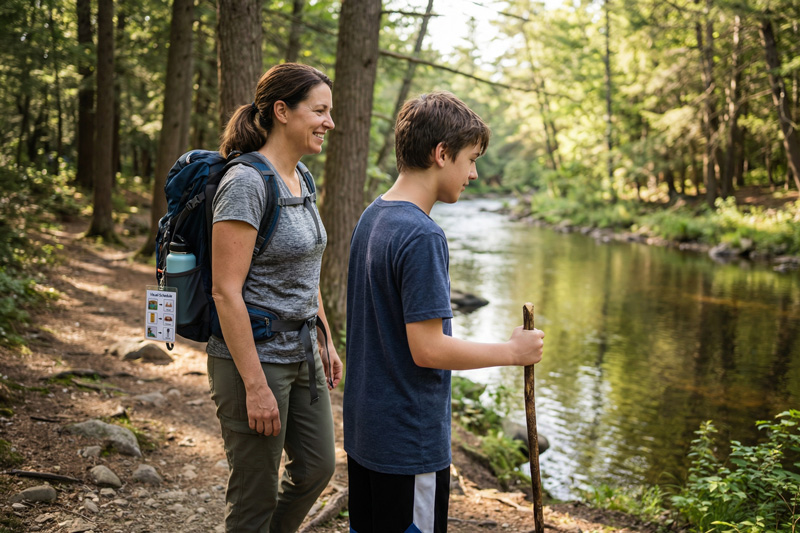
Preparation and planning—according to the parents—were critical for minimizing their teens’ sensory overload and anxiety. Many families used visual schedules, previewed locations in advance, and visited nature sites during off-peak hours. Parents highlighted the importance of bringing headphones, walking sticks, and a small backpack with snacks on every outing. In addition, parents highlighted the importance of having clear exit plans when their teens became too overwhelmed. Four parents devised communication solutions, such as walkie-talkies to compensate for limited cell phone coverage or cue words signaling it was time to leave. Parents recommended short hikes spread out across days rather than one long nature outing. One parent plans several short outings in new areas—so their teens could become accustomed to the trails—before progressing to longer outings in the same area. “Seeing my daughter hiking, feeling calm, and exploring is worth all the planning,” a mother reflected.
Safety concerns. Parents reported constant vigilance when trails included water, cliffs, or steep drop-offs, noting that the lack of enclosed areas or protective barriers limited how much they could relax during outings. One dad mentioned that many trails are technically “accessible” but not realistic for autistic teens who tire easily or need constant supervision. The parents provided a good reminder that even though their autistic kids were now teens, it did not mean they didn’t still run off. One dad said, “My teen still runs off when dealing with sensory overload, the only difference now between when they were little, I cannot easily stop them.” Services that many people do not realize can hinder accessibility for autistic families are lack of close parking or parking that provides ample space to exit or enter the car, lack of bathrooms at the beginning of trails, and steep or uneven trails. Additionally, parents reported being anxious because of others—disapproving looks or comments from others when teens were experiencing meltdowns. One mom said, “While on a trail, my son started having a meltdown and this stranger walked by and just stared at my son, which caused my son to yell at the stranger to stop staring which then led to a scene. We have not gone back to that trail, and it was so beautiful.” Another mom agreed and said they stopped visiting popular nature areas for similar reasons.
Benefits. Despite the challenges, parents reported benefits after nature outings. Many describe outdoor environments, especially areas near water, as calming for their teens, often leading to improved sensory regulation, reduced agitation, and better sleep at night. One parent noted that their daughter “is happy outdoors and socializes more,” highlighting how nature spaces may provide a context where autistics feel less overwhelmed and as a parent said, “A sense of just ahhh…where your whole body relaxes.” Parents also observed that when in nature there aren’t the same social norms surrounding communication. One mom said their teens have fun making loud sounds in the dense forests to hear the echo and he loves it when others walking the trail make similar noises in return. Overall, parents reinforced the importance of nature’s low-stimulus environment, allowing their autistic teens to be themselves, quirky behavior and all.
Ideal outdoor experiences. Parents envisioned a balance between structure and flexibility, emphasizing visits during times when fewer people were present. Two dads mentioned the need for more park rangers who understand autism, sensory regulation and communication differences. Parents mentioned design features, such as wide trails, shaded paths, and quiet sitting spots distributed along hiking routes. These features allow teens to regulate their sensory input while reducing the constant supervision burden on parents. A father shared, “If the trail is fairly smooth and there are benches along the trails, we collect little wins — he stays engaged, and we can stay longer.” Parents particularly valued environments where safety concerns were minimized, such as enclosed areas or trails without steep drop-offs. One parent described a trail with exercise stations—push-up bars, monkey bars—along the route, suggesting that integrated activity stations may increase engagement of autistics while supporting physical development.
Autonomy. During outings, parents reported that allowing teens to explore at their own pace—choosing when to pause, sit, or continue—helped regulate sensory input and reduced the likelihood of meltdowns. Over time, families developed a process of reflecting on which aspects of outings promoted calm or triggered anxiety, enabling them to refine strategies for future trips. One dad said, “We learned from a previous camping trip—it failed—that camping in our backyard before going on our next weekend camping trip was all it took to make it more successful.” These findings support research (e.g., Kormanik, 2024) emphasizing the importance of autonomy for autistic individuals.
Developmental. The benefits parents described extended beyond sensory regulation to physical, emotional, and social domains. Outdoor activities supported gross motor development through walking, climbing, and exploring varied terrain. Nature environments were also perceived as low-pressure settings where teens could interact with family or peers without the intense social demands often present in structured environments. Several parents suggested that nature-based experiences countered sedentary habits typical of teens—summarized by one mom as the tendency to “sit on the couch and play video games.” Nature outings also strengthened family bonds by creating shared experiences that emphasized enjoyment rather than therapy.
Recreation professionals, including therapists, park rangers and park staff—can use these findings to design more inclusive nature experiences. Creating quiet, sensory-friendly zones away from high-stimulus areas such as roads or crowds can improve accessibility. Visual trail signs indicating shade, water features, open spaces, and level of difficulty can increase predictability and help autistic individuals navigate trails more independently. Small modifications such as recommending less crowded trails or designing maps highlighting rest points, bathrooms, and easy exit routes may further increase participation by balancing autonomy with safety. During interactions with autistic families, park staff and rangers should communicate calmly using simple, direct language, allow extra time for responses, and avoid sudden physical contact. If a teen becomes overwhelmed, staff can assist families in moving to a quieter area to reduce sensory stimulation. In cases where a teen wanders, rangers can initiate search procedures and approach calmly when locating them.
In conclusion, these interviews highlight that nature-based experiences can offer meaningful benefits for autistic teens when the outings are designed with predictability, safety, and flexibility in mind. While families often face barriers, intentional preparation and support can transform outdoor spaces into places of regulation and connection. Ultimately, when barriers are reduced and a teen’s autonomy is supported, nature becomes a powerful setting where autistic teens and their families experience relaxation, growth, and a sense of belonging.

Heidi Hillman, PhD, BCBA-D, LMHC, is an autistic researcher and professor at Eastern Washington University. For more information, please contact Heidi Hillman at [email protected].
References
Bradley, E., & Male, D. (2017). Autism and outdoor learning: Benefits and challenges. Support for Learning, 32(2), 153-169.
Daly, G., Jackson, J. & Lynch, H. (2022) Family life and autistic children with sensory processing differences: A qualitative evidence synthesis of occupational participation. Frontiers in Psychology, 13, 940478. doi: https://doi.org/10.3389/fpsyg.2022.940478
Fan, M. S. N., et al. (2023). Nature-based interventions for autistic children: A systematic review and meta-analysis. Journal of American Medical Association Network Open, 6(12), e2346715. https://doi.org/10.1001/jamanetworkopen.2023.46715
Li, D., et al. (2019). Exposure to nature for children with autism spectrum disorder: Benefits, caveats, and barriers. Health & Place, 55, 71-79. https://doi.org/10.1016/j.healthplace.2018.11.005
Jimenez, M. P., DeVille, N. V., Elliott, E. G., Schiff, J. E., Wilt, G. E., Hart, J. E., & James, P. (2021). Associations between nature exposure and health: A review of the evidence. International Journal of Environmental Research and Public Health, 18(9), 4790. https://doi.org/10.3390/ijerph18094790
Kormanik, A. (2024). Harnessing the power of nature: Outdoor sensory activities for autistic children. Autism Spectrum News. https://autismspectrumnews.org/outdoor-sensory-activities-for-autism-spectrum-disorder
Lomax, T., Butler, J., Cipriani, A., & Singh, I. (2024). Effect of nature on the mental health and well-being of children and adolescents: meta-review. The British Journal of Psychiatry, 225(3), 401–409. https://doi.org/10.1192/bjp.2024.109
Moll, A., Collado, S., Staats, H., & Corraliza, J. (2022). Restorative effects of exposure to nature on children and adolescents: A systematic review. Journal of Environmental Psychology, 84, 1-10.
Salar, S., et al. (2024). Barriers to physical activity participation in children and adolescents with autism spectrum disorder. Healthcare, 12(23), 2420. https://doi.org/10.3390/healthcare12232420
Salar, S., Jorgić, B. M., Olanescu, M., & Popa, I. D. (2024). Barriers to physical activity participation in children and adolescents with autism spectrum disorder. Healthcare, 12(23), 2420. https://doi.org/10.3390/healthcare12232420