There is an order to all things I do. To how things must be done.
I start at the beginning and end at the end. I move in one direction.
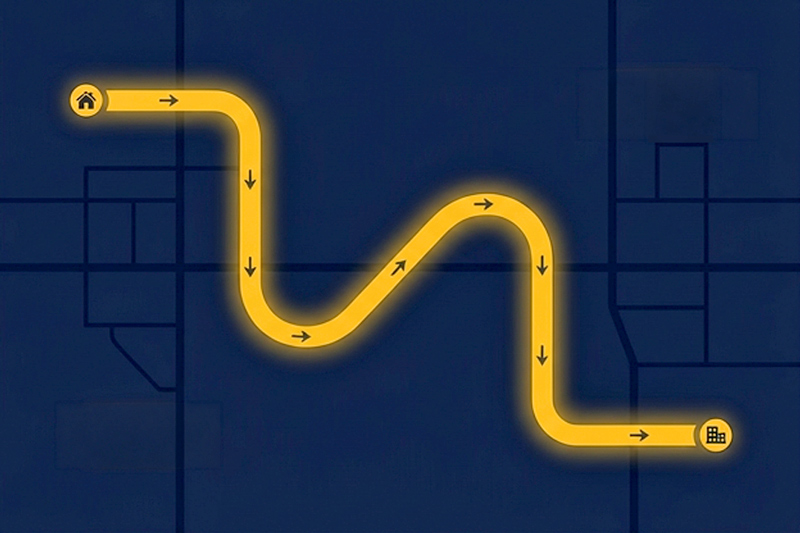
For instance, when you go somewhere, you must go straight there. Backtracking is not permitted. Detours are not permitted. They break the law.
If you have to go to two different places and one is enroute to the other, then you go to the farther one (from home) first and the nearer one (to home) second. But you can’t pass close by the nearer place enroute to the farther place. You have to find a logical path that takes you far enough away from the nearer place that you aren’t obviously “missing” or “skipping” that trip, even temporarily (this would be a very agitating experience, and you also would be obsessively reminding yourself of the need to return to the nearer place).
If the nearer place is very near to your home (less than one kilometre), then it’s best to make that your initial destination so that you can go straight home from the farther place without having to stop somewhere so close to home first. You wouldn’t want to do this, knowing you’re so close to your safe place yet can’t immediately get there. You’d end up abandoning that trip and having to complete it another day. However, if you go to this very near place first, then you’d have to find a way to continue to the farther place without passing by your home. To meet this non-negotiable condition, you might have to travel out of your way to get to the farther place.
As long as you don’t backtrack or cross an already trodden path (you were already there, and you can’t go back on that trip) or pass close by a nearer place enroute to the farther place, you can go to multiple places in a row (from farther to nearer, linearly) before returning home.
The most important rule is that you cannot pass by or near your home during your travels. If your route from A (farther) to B (nearer) would take you past or close to your home, then you would have to abandon that trip.
Complications arise when you want to go to two different places and there is no clear, well-defined route to access both without breaking any of the above rules. Perhaps both places are in different parts of the city, with your home in the middle, or the transit links aren’t direct or convenient. Then you go on different days. Or you choose one trip and abandon the other. You compromise.
Complications also arise depending on trip purpose. For example, if you want to return something to a store, that trip always takes primacy (you don’t want to hold on to something that shouldn’t be with you, that is wrong for whatever reason — you feel panicky and need to get rid of this item as soon as possible, to purge it from your space). In this case, the store would be your first trip, even if it is the nearer location. Then you can visit the farther location (if there are two or more destinations planned, and as long as the farther location is not too distantly located from the nearer location and the trip back doesn’t take you past the nearer, already visited, location). Similarly, if you want to buy something large and/or heavy (and there is not enough space for it in your backpack), then that location would necessarily be your final trip of the day even if it was nearer to home than earlier destinations. You would plan your day’s journey accordingly.
While compromises are sometimes possible (to an extent — backtracking, detours, and passing by your home are absolutely prohibited), the entire “out of order” trip chain is fraught with anxiety and worry. With constant reminders about the trips that still need to be made that day and the order in which they’ll be made.
I’m a mess until everything falls into place, and even more of a mess if something doesn’t go to plan. If my trip is interrupted or thrown into disarray because of an unexpected snag, like a transit delay, an out-of-stock item, a too-noisy environment. Until everything’s been done and I’m back home, I’m a rumbling volcano.
In addition to the order in which destinations are visited, there are other rules to follow. These rules govern my conduct as I follow my itinerary. For instance, and most critically, I don’t take breaks. No breaks. I have a mission to accomplish, and I need to accomplish it as quickly and smoothly as possible. I don’t want anything to stand in my way. My anxiety blows up when my progress is interrupted. I can’t bear the sense of incompleteness. I can’t sit with knowing things are unfinished, imperfect. My anxiety is compounded when the task that must be undertaken at my intended destination requires more than a very basic interaction with another human. I predict conflict. I’m aware that I don’t have the communication or emotional skills to handle anything going other than perfectly smoothly, and I want to get these things over with as quickly and efficiently as possible. Breaks impede my progress. They delay the inevitable grief. They are unbearable.
Sometimes there’s an unexpected snag in my itinerary, but it’s of my own doing. For example, if I miss my transit stop. I have to get back to where I was supposed to be as quickly as possible. If it’s a bus or streetcar stop, then I walk as speedily as I can back to my destination. All the way, I panic. I perseverate: “I’m not supposed to be here. This doesn’t feel right. I’m not supposed to be here. This doesn’t feel right.” I’m in emotional agony. Almost physical agony. If it’s a subway stop that I missed, then I have to take the subway back in the direction I came from. Depending on the station layout, I either have to run upstairs, cross the station, and run down the opposite staircase (all while anxiously dodging people in my way) — absolute internal chaos — or I have to switch platform sides. Either way, it feels like my body is going to explode from the panic coursing through me. Then I have to wait for the train to take me back to where I belong. I count the seconds and feel the time oppressively taunting me. “I don’t belong here. This feels horrible. I’m in the wrong place. I need to get away from here.” This agitated monologue continues until I’ve returned to my intended destination. Even then, I remind myself that I’m several minutes behind time and try to compensate for the loss, try to get myself to where I would have been had I not messed up. Perhaps get myself “back to the future.”
Missing my stop is not acceptable. It is not how things are supposed to go.
Another difficulty I encounter when planning my route is managing diverging branches. During my travels, I sometimes have to choose between two or more equally acceptable routes to my destination. I’m referring specifically to the “last mile” part of a route — I’ve come as close as possible with transit to my destination, and I have to walk the rest of the way. Being confronted with this choice causes me anxiety. Whatever route I select, I will have left one behind. More than not being able to explore that route/section of the total journey (particularly if it’s an area of the city that’s new to me and I want to see what’s there), the anxiety comes from a sense of incompleteness, of having rejected one path in favour of the other. I need to feel like things are complete, finished. That I’ve physically covered all possible options and I’m not missing out on something. To a lesser extent, I also don’t want to allow one route to feel less important than the other (I understand that objects and ideas don’t have feelings, but I’m not always positive). I ultimately decide which route to take, invent a reason for why one is slightly preferred, but the amount of calculation and reasoning and explanation involved is overwhelming, and the result is never wholly acceptable.
This is what it means to move through the world so rigidly. “One direction” is not a metaphor, not a preference, but a set of rules I did not choose and cannot ignore. I used to think something was wrong with me for needing things to work like this. Now I understand it is simply how my mind holds order in a world that rarely offers any. The anxiety doesn’t disappear by following these rules. But naming it, mapping it, writing it down like this, gives me something I didn’t have before: the knowledge that this is not chaos. It is a system. And it is mine.

Rhonda Cheryl Solomon, MSc, PhD (cand.), at the University of Toronto can be reached at [email protected] or (416) 820-9654.