Imagine a ten-year-old being asked to put away a tablet and join the reading circle. They do not move. A teacher’s aide repeats the instruction, a little louder and a little slower, as though volume were the missing ingredient. The student still does not move.
In another classroom, a teacher notices the same hesitation in a different student and says, “Two more minutes, then the blue chair.” The student finishes what they are doing and walks over.
Neither moment tells us enough to conclude defiance. The more useful question is what may be making the transition difficult and what information or support the student needs next.
That is the heart of practical classroom support. It is built around a specific student, not around a category. Autistic students vary widely in their strengths, communication styles, sensory experiences, learning profiles, and support needs. The IRIS Center at Vanderbilt University emphasizes that the strengths and needs of students with autism vary greatly and that educators should individualize the supports they provide (IRIS Center, n.d.-a). A strategy that helps one student may be unnecessary, ineffective, or uncomfortable for another.
Communication Is Not One Channel
A common assumption in schools is that spoken language is the “real” communication and everything else is a workaround. Typing, gestures, picture systems, sign, and augmentative and alternative communication (AAC) may be treated as secondary options rather than valid ways to communicate.
That hierarchy can create unnecessary barriers. Donaldson and colleagues describe how AAC has often been treated as a last resort, even though speaking autistic adults have reported that they would have benefited from access to AAC as children. They argue for communication access, choice, and agency, including multimodal communication regardless of a student’s spoken-language status (Donaldson et al., 2023).
For classroom staff, this means resisting the urge to remove a communication tool simply because a student is speaking more on a particular day. It also means noticing changes without immediately judging them. A student who usually speaks in full sentences and begins pointing, typing, or going quiet is not necessarily refusing or “losing” a skill. The change may simply tell adults that communication is harder in that moment.
Sensory Support Has to Be Specific
Sensory differences are mentioned frequently in autism training, but vague labels are not very actionable. “Sensitive to noise” tells a teacher far less than “finds the cafeteria difficult when chairs scrape and several groups are talking at once.”
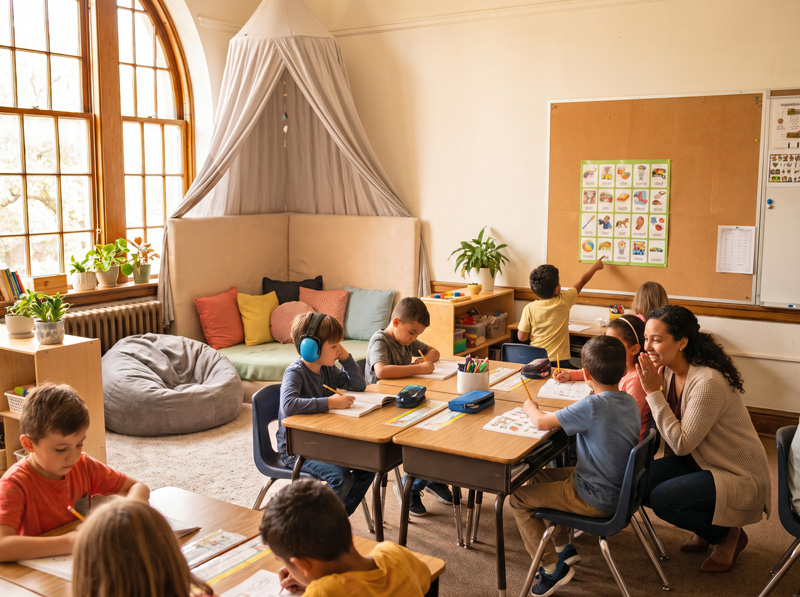
The National Autistic Society notes that autistic pupils may be over-sensitive, under-sensitive, or both to sensory input, and that experiences can differ from one person to another and at different times. It recommends individualized adjustments such as reducing unnecessary noise or visual clutter, offering headphones or a quieter space, and changing aspects of the environment that are creating difficulty (Cutting, 2019).
The practical response is not to assume every autistic student needs the same sensory tools. It is to identify which parts of the environment are difficult for this student and which changes actually help. Sometimes that may be a seat away from a busy doorway, less visual clutter, or access to noise-reducing headphones during appropriate activities. Depending on the setting and the adjustment, staff may also need to document accommodations through the student’s existing school support or education plan.
Transitions Deserve Deliberate Planning
Moving from one activity, room, or expectation to another can carry more demand than adults realize. A substitute teacher, an assembly, a fire drill, or a timetable change can remove the predictability a student relies on to understand what is happening next.
The IRIS Center recommends creating structure and predictability, including consistent routines, clearly structured transitions, and visual supports. Its guidance also stresses that visual schedules should be individualized for the learner (IRIS Center, n.d.-b).
In practice, a teacher might give advance notice, show a change on a visual schedule, provide a brief written cue, or let a student see a new room before an event begins. When advance notice is impossible, calm and concise information may be more useful than repeated instructions or pressure for an immediate response.
The aim is not to eliminate every change. School is full of unexpected moments. The aim is to reduce avoidable confusion and give the student enough information to understand what comes next.
Breaks Should Be Accessible Before Crisis
A break should not become something a student can access only after distress is obvious to everyone else in the room.
Some students benefit from a low-effort way to signal that they need space: a card on the desk, a gesture, an AAC button, a written note, or a specific word. The National Autistic Society includes stress-alert or time-out cards and access to calm spaces among examples of reasonable sensory adjustments for autistic pupils (Cutting, 2019).
If a student is already experiencing sensory overload, adding more language can make processing harder. Guidance from the National Autistic Society recommends keeping speech and information to a minimum during overload and allowing enough time and space for recovery (National Autistic Society, n.d.-a).
That does not mean ignoring safety or removing every difficult demand. It means recognizing that the middle of distress is often a poor time for detailed explanations, repeated questioning, or immediate problem-solving. A student who looks calm again may still need a little time before returning to complex conversation or academic work.
Stimming Is Not Automatically a Problem
Rocking, hand-flapping, repeating a phrase, or tapping a pencil in a steady rhythm can attract adult attention even when the behavior is not preventing anyone from learning.
Research with autistic and non-autistic adults found that participants described stimming as serving self-regulatory functions and that social pressure to suppress it could have negative effects (Charlton et al., 2021). The National Autistic Society similarly describes many forms of stimming as beneficial and usually harmless, while noting that support may be needed when a stim is harmful or unsafe (National Autistic Society, n.d.-b).
That distinction matters in classrooms. If a stim is unsafe or significantly interferes with the student’s or classmates’ access to learning, staff may need to respond. Otherwise, the better first question may be what the behavior is doing for the student and whether something in the environment needs attention.
A movement that looks unusual to an adult is not automatically a classroom problem.
The Student’s Input Should Shape the Support
Adults can gather valuable observations, but they are still interpreting another person’s experience. Whenever possible, autistic students should have a meaningful way to communicate what helps, what does not, and what they would prefer adults to do.
That participation does not depend on fluent speech. A student might indicate a preferred break location through AAC, choose between seating options, point to a visual, write a response, or explain directly why a particular transition is difficult. The communication method should not determine whether the preference counts.
Student input can also help make sense of differences between settings. A student may manage a noisy school day and need substantial quiet afterward, or communicate more comfortably in one environment than another. Those differences are not necessarily contradictions. They are clues about how different environments and demands affect the same person.
Practical support is rarely dramatic. It is the accumulated effect of adults noticing patterns, making expectations clearer, respecting communication, adjusting the environment, and changing course when a strategy does not fit.
The aim is not to make an autistic student appear less autistic. It is to make the classroom more accessible so the student can communicate, participate, learn, and recover from difficult moments without spending unnecessary energy overcoming barriers adults can reasonably reduce.
Good support begins there: with the student in front of us, not the stereotype we expected to meet.

Farhan Ur Rehman Khan is Founder and Author of Health Info Guides. He can be reached at www.healthinfoguides.com, [email protected], or +92 325 2868339.
References
Charlton, R. A., Entecott, T., Belova, E., & Nwaordu, G. (2021). “It feels like holding back something you need to say”: Autistic and non-autistic adults’ accounts of sensory experiences and stimming. Research in Autism Spectrum Disorders, 89, 101864. https://doi.org/10.1016/j.rasd.2021.101864
Cutting, A. (2019). Reasonable adjustments for autistic pupils’ sensory differences. National Autistic Society. https://www.autism.org.uk/learn/knowledge-hub/professional-practice/adjustments-sensory
Donaldson, A. L., corbin, e., Zisk, A. H., & Eddy, B. (2023). Promotion of communication access, choice, and agency for autistic students. Language, Speech, and Hearing Services in Schools, 54(1), 140–155. https://doi.org/10.1044/2022_LSHSS-22-00031
IRIS Center. (n.d.-a). Autism (Part 1): An Overview for Educators. Vanderbilt University Peabody College. https://iris.peabody.vanderbilt.edu/module/asd1/
IRIS Center. (n.d.-b). The Learning Environment. In Autism (Part 1): An Overview for Educators. Vanderbilt University Peabody College. https://iris.peabody.vanderbilt.edu/module/asd1/cresource/q2/p06/
National Autistic Society. (n.d.-a). Autism and sensory processing. https://www.autism.org.uk/advice-and-guidance/about-autism/sensory-processing
National Autistic Society. (n.d.-b). Repeated movements and behaviour (stimming). https://www.autism.org.uk/advice-and-guidance/about-autism/repeated-movements-and-behaviour-stimming