Last April, I found myself in a Stockholm studio, sitting next to my college buddy Spencer Reece, with whom I’d taken my first creative writing course forty-three years ago—our teacher was the Pulitzer Prize winning author Annie Dillard. We had traveled to Sweden to teach our own creative writing course and were appearing on the Swedish podcast “With Hope for a Better Life”. The episode was devoted to the topic of creativity, whose benefits are numerous: from countering loneliness to alleviating stress to improving one’s mood to building resilience to expanding self-awareness to relishing surprise to establishing community. Many of these effects have been corroborated by empirical investigation. At one point, my friend Spencer said that poetry had saved his life. It had helped him to climb out of alcoholism and to move toward God. Following the example of his hero, the 17th Century English poet-priest George Herbert, Spencer became a priest in 2011.
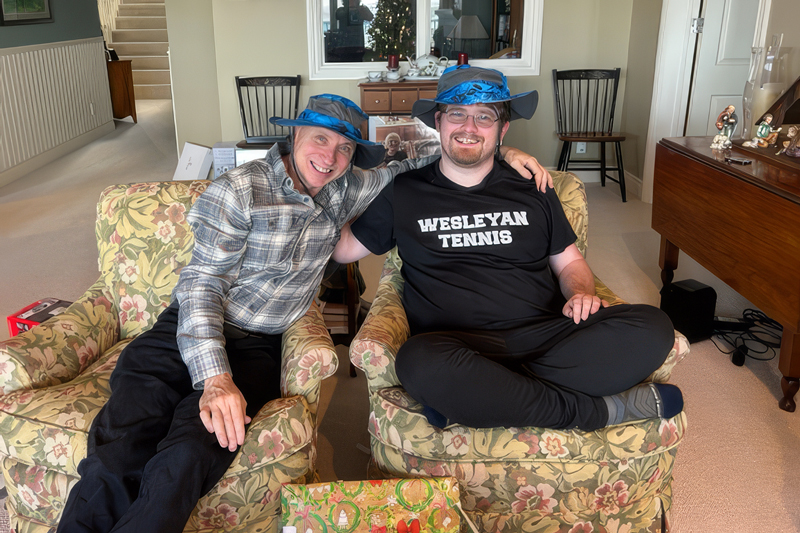
Ralph James Savarese with his son DJ
I spoke on the podcast about fostering creativity in the nonspeaking autistic community. For more than twenty years, I have taught free poetry writing classes and one-on-one tutorials to young people who type or spell to communicate. For the last eight years, I’ve taught these classes with my son who is himself nonspeaking and whom I adopted from foster care at the age of six. (He carried the label of “profound mental retardation”). A Phi Beta Kappa graduate of Oberlin College and the subject, writer and coproducer of the Peabody Award winning documentary Deej, he is also the author of three volumes of poetry. At Oberlin, he was lucky enough to take a course on the teaching of poetry writing from the poet Lynn Powell. We know from the evaluations that our students relish the opportunity to learn from one of their own and to see a father-son team so passionately in action. Because we provide rigorous instruction and feedback, students get a taste of the wondrous difficulty of making genuine art. It’s a laboratory for growth. We take them seriously by having them reach for the stars.
Poetry saved our lives, too, we’d say wholeheartedly. It did so by establishing a form of joint attention that could see us through the horrors of my son’s early years and the exclusionary prejudices of an ableist society, all the while offering palpable, sensory-driven pleasure. One of the first things my son typed on a computer concerned a poem by Dylan Thomas called “Fern Hill,” which recounts the summers the poet spent as a child on his aunt’s farm and which I had read aloud to my wife. “Now as I was young and easy under the apple boughs,/ About the lilting house and happy as the grass was green,/ The night above the dingle starry…” “Very great sound,” my son typed. “Very great sound.” His pattern-detecting ear had discovered the delivery mechanism of emotionally infused beauty, what scientists call a poem’s foregrounding aspects: meter, rhyme, consonance, assonance, alliteration… (frontiersin.org; sciencedirect.com; jbe-platform.com). As one study puts it, “[Our] results point to a similarity between the neural basis of the emotional response to music…and literature, which, in the case of poetry especially, exploits the musical properties of language to emotional effect.” When he was older, my son offered a semantic paraphrase of the poem, explaining that “Thomas captures the dewy feeling of the world when you are small.” Yet, as I’ve been arguing for years in print — I work as a professor in the field of neurohumanities — it’s the way that a poem lives in your body that counts.
If you listened to the research literature from the last fifty years, which claimed that autistic people suffer from impairments in imagination, figurative language, and theory of mind, you would have believed that poetry was a waste of time for your autistic child.1 This literature no doubt explains why we’ve tracked autistic students into math and science classes in schools, if we’ve mainstreamed them at all. When I interviewed Temple Grandin for my 2018 book, See It Feelingly: Classic Novels, Autistic Readers, and the Schooling of a No-Good English Professor, she not only recalled with pleasure studying Romantic poetry as an undergraduate, but she also recited a poem by Wordsworth that she’d memorized fifty years prior! What is more, for weeks after the interview, she called to discuss other poems from that class. This is not the portrait of Grandin that emerges in Oliver Sacks’ New Yorker profile, where he says plainly that art eludes her. The point of my book was to show, by emphasizing the generation of sensuous mental imagery while reading literature, that autistics across the spectrum might actually have a special talent for it. Grandin, of course, speaks of “thinking in pictures.” Add feeling and the other sensory modalities to the phrase, and you have a perfect description of what poems and stories facilitate.
Coming from another place of concern, if you worried that strong emotion in a poem, from difficult content, might overwhelm your autistic child, you likely missed a fundamental paradox of the art form. I was certainly worried about this with my son whose trauma triggers were profound, and I’m an English professor! In the words of one study, “Peak aesthetic pleasure can co-occur with physiological markers of negative affect.” Much is compressed into this statement, not least of which is that a poem about a horrific life event can be beautiful and that its beauty, while distressing, can also be pleasurable. The poem’s formal techniques, you could say, both provoke distress and protect from overload by allowing the seasoned reader to regard the aesthetic delivery system as a form of exquisite control. Poetry, in short, can teach you how to manage overwhelming emotion. Another study, this one from The Journal of Poetry Therapy, says something similar by conceiving of the lyric “I” as “a psychological space through which writers can explore emotion, memory, and identity with a degree of reflective distance.”
Anxiety is a big challenge in autism, especially its nonspeaking variety. Aside from any trauma that an individual may have experienced, the nervous system, like a car, idles very high. In an interview with the nonspeaking autistic writer Tito Mukhopadhyay, whom I’ve mentored for two decades — we meet every Saturday by Zoom to discuss the book we are currently reading and the writing he has recently done — the comforting aspects of rhyme and meter, which give Tito a “secure feeling,” came up. “A rhyme is a very linear auditory experience,” he explained.
And so is the beat — be it in tetrameter or in pentameter. It arouses the cortical mind with certain meaningful language experience and arouses the subcortical mind with the expectation of the mechanical beat that is offered by the lines of the poem. Anxiety is subcortical. Anxiety gets diluted by the experience. That is what makes it soothing.
We might think of metrical poetry as a kind of limbic system cane, aiding what Frederick Turner and Ernst Poppel call the brain’s “synthetic and predictive activity of hypothesis construction.” By that they mean our ability to answer the question “What’s next?” without overly taxing the system. “By ruling out certain rhythmic possibilities,” Turner and Poppel write, “meter satisfies the brain’s procrustean demand for unambiguity and clear distinctions. By combining elements of repetition and isochrony [the rhythmic division of time into equal proportions] on the one hand with variation on the other, it nicely fulfills the…habituative need for controlled novelty.” In this form of autism, where everything is perceived in its irreducible particularity, making the business of quick generalizations more difficult, controlled novelty is a lifeline. At least two studies support the salutary physical effects of meter, showing how it can correct for cardiorespiratory decoupling due to nervous system imbalance and stress (sciencedirect.com; journals.physiology.org). Thirty minutes of hexameter recitation more effectively recoupled heart rate and breathing than conventional therapeutic exercises.
Promoting self-discovery and self-expression, teaching compositional techniques and feeling management, enhancing autistic pride through sensory advantage, building community, and providing a rich form of accommodation, creative writing classes seem to this scholar and poet anything but an inessential extra. “Very great sound. Very great sound,” we might all say together.
Ralph James Savarese with his son DJ
Ralph James Savarese is the author of seven books, most recently “Herman Melville and Neurodiversity” (Bloomsbury 2024), and the coeditor of four collections, including the first on the topic of neurodiversity. He has received awards from the National Endowment for the Humanities, the Mellon Foundation, and the Herman Melville Society, and he has been a fellow at Duke University’s Institute for Brain Sciences. To contact Ralph, email [email protected].
Footnotes
- In a series of scholarly articles, I demonstrate the need to modulate the prevailing view, arguing that many autistics possess both enormous sensitivity to figurative language and keen theory of mind. See “The Lobes of Autobiography: Poetry and Autism,” Stone Canoe 2 (2008); “Toward a Postcolonial Neurology: Autism, Tito Mukhopadhyay, and a New Geo-poetics of the Body,” Journal of Literary and Cultural Disability Studies 4.3 (2010); “Gobs and Gobs of Metaphor: Dynamic Relation and a Classical Autist’s Typed Massage,” Inflexions 5 (2012); “From Neurodiversity to Neurocosmopolitanism: Beyond Mere Acceptance and Inclusion,” Ethics and Neurodiversity, Eds. C.D. Herrera and Alexandra Perry, Cambridge Scholars Publishing (2013); “The Critic as Neurocosmopolite: What Cognitive Approaches to Literature Can Learn from Disability Studies,” Narrative 22.1 (2014); and “I Object: Autism, Empathy, and the Trope of Personification,” Rethinking Empathy through Literature, Eds. Sue Kim & Meghan Marie Hammond, Routledge (2014).
Works Cited
Henrik Bettermann, Dietrich von Bonin, Matthias Frühwirth, Dirk Cysarz, Maximilian Moser. “Effects of speech therapy with poetry on heart rate rhythmicity and cardiorespiratory coordination,” International Journal of Cardiology 84.1 (2002).
Ducel Jean-Berluche. “Creative Expression and Mental Health,” Journal of Creativity 34.2 (2024).
Dirk Cysarz, Dietrich von Bonin, Helmut Lackner, Peter Heusser, Maximilian Moser, and Henrik Bettermann. “Oscillations of Heart Rate and Respiration Synchronize during Poetry Recitation,” American Journal of Physiology-Heart and Circulatory Physiology 287.2 (2003).
Anna Gennerud. “How Creativity Can Save Lives,” With Hope for a Better Life (podcast). May 15, 2026.
Temple Grandin. Thinking in Pictures. New York: Vintage, 2010.
Arthur M. Jacobs, Jane Ludtke, Arash Aryani, Burkhard Meyer-Sickendiek, and Marcus Conrad. “Mood-Empathic and Aesthetic Responses in Poetry Reception.” Scientific Study of Literature 6.1 (2016).
Maitray Kaushik. “The lyric ‘I’ as a Therapeutic Third: Poetic Selfhood, Symbolic Mediation, and Emotional Processing in Expressive Writing. Journal of Poetry Therapy (2026).
Philip N. Johnson-Laird and Keith Oatley. “How Poetry Evokes Emotion,” Acta Psychologica 224 (2022).
Christian Obermeier, Winfried Menninghaus, Martin von Koppenfels, Tim Raettig, Maren Schmidt-Kassow, Sascha Otterbein, and Sonja A. Kotz. “Aesthetic and Emotional Effects of Meter and Rhyme in Poetry,” Frontiers in Psychology 4 (2013).
Oliver Sacks. “An Anthropologist on Mars.” New Yorker Magazine. December 20, 1993.
D.J. Savarese, Deej. Rob Rooy Media (2017).
Ralph J. Savarese, “From Neurodiversity to Neurocosmopolitanism: Beyond Mere Acceptance and Inclusion,” Ethics and Neurodiversity, Eds. C.D. Herrera and Alexandra Perry, Cambridge Scholars Publishing (2013)
– “Gobs and Gobs of Metaphor: Dynamic Relation and a Classical Autist’s Typed Massage.” Inflexions 5 (2012). http://www.inflexions.org/n5tSavarese.pdf.
– “I Object: Autism, Empathy, and the Trope of Personification,” Rethinking Empathy through Literature, Eds. Sue Kim & Meghan Marie Hammond, Routledge (2014).
– “The Lobes of Autobiography: Poetry and Autism.” Stone Canoe 2 (2008): 61-78.
– “More Than a Thing to Ignore: An Interview with Tito Rajarshi Mukhopadhyay,” Disability Studies Quarterly 30.1 (2010).
– See It Feelingly: Classic Novels, Autistic Readers, and the Schooling of a No-Good English Professor. Durham: Duke University Press (2018).
– “Toward a Postcolonial Neurology: Autism, Tito Mukhopadhyay, and a New Geo-poetics of the Body,” Journal of Literary and Cultural Disability Studies 4. 3 (2010): 273-289.
– “What Some Autistics Can Teach Us about Poetry: A Neurocosmopolitan Approach.” The Oxford Handbook of Cognitive Literary Studies, edited by Lisa Zunshine, Oxford University Press (2015).
Dylan Thomas. “Fern Hill,” Deaths and Entrances. London: J. M. Dent & Sons (1946).
Frederick Turner and Ernst Poppel. “The Neural Lyre: Poetic Meter, the Brain and Time,” Poetry Magazine 142.5 (1983).
Eugen Wassiliwizky, Stefan Koelsch, Valentin Wagner, Thomas Jacobsen, Winfried Menninghaus. “The Emotional Power of Poetry: Neural Circuitry, Psychophysiology and Compositional Principles. Social, Cognitive and Affective Neuroscience 12.8. (2017).
Adam Zeman, Fraser Milton, Alicia Smith, and Rick Rylance. “By Heart: An fMRI Study of Brain Activation by Poetry and Prose.” Journal of Consciousness Studies 20.9 (2013).