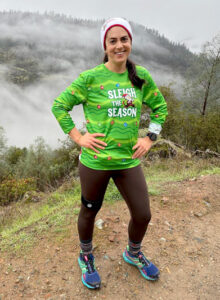
Getting up at 4:40 a.m. most mornings is hard. I want to stay in my warm bed. I can find no logical reason to get up that early to run in the cold, but I need the miles. I am training for a 100k race, and it’s only a few short weeks away. My sleepy brain argues with me: can’t I just take a day off today? I remind myself: consistency. Relentless forward motion.

Danielle, during a group trail run in Auburn, California.
It sounds harsh, but it isn’t. My life has always felt like a tension between stagnation and forward motion. I choose forward motion. It is uncomfortable. It requires repetition. But the results are worth it.
When I arrive at an event I’ve trained for—when the timer starts and I test my body, when I run for hours in quiet woods wondering if I should quit or push a little further—and I push, and discover I can go farther than I believe I feel something shift. It isn’t just physical strength. It is regulation. It is attunement with myself.
Endurance as Chosen Regulation
I never considered endurance racing until recently. As an autistic person, I associated races with crowds, unpredictability, and performance. Being perceived while exerting myself sounded overwhelming.
For most of my adult life, I ran privately to regulate—accessing dopamine, reducing stress, and finding relief in nature. But racing introduced a different dimension: structure.
Much of autistic life requires endurance already. Masking. Navigating sensory overload. Interpreting social nuance. Suppressing natural rhythms to meet external expectations. Research on autistic burnout describes the cumulative exhaustion that results from chronic masking and life stress (Dora M. Raymaker et al., 2020). That framework resonated deeply with my lived experience.
What struck me about endurance sport was this: it transformed unconscious survival endurance into chosen endurance. The stress was intentional. The discomfort had boundaries. There were clear rules, a start line, a finish line. Achieving something I wanted.
Also, collecting medals and organizing them is fun!
Nature and the Nervous System
Trail running introduced another element I hadn’t anticipated—the profound regulation of being in natural environments.
There is growing evidence that interacting with nature improves cognitive functioning and reduces mental fatigue (Marc G. Berman et al., 2008). For someone whose nervous system often runs hot from sensory and social input, hours in the woods offer something rare: quiet predictability.
The rhythm of running—left, right, left, right—feels organizing. Forward motion without complex social demand. Just breath, ground, and distance.
It is low demand, but high return.
Parallel Play in Adulthood
From the outside, ultra running appears solitary. In reality, it is communal—but in a way that feels surprisingly accessible.
Autistic adults are often described as socially impaired, yet emerging scholarship challenges that deficit framing. The “double empathy problem,” introduced by Damian Milton (2012), suggests that social breakdowns between autistic and non-autistic individuals arise from mutual misunderstanding rather than inherent autistic deficiency.
In endurance spaces, I have often felt less of that mismatch. Conversations are structured and topic-centered: pacing strategies, fueling methods, elevation gain. Info dumping is welcomed. Silence is acceptable. You can run beside someone for miles without pressure to maintain eye contact or fill conversational gaps. The social expectations are low.
It feels like parallel play for adults—together, but not too intensely other focused.
For someone who has spent much of her life calculating social rules, navigating the social rules of the running world has been a welcome relief.
Dopamine, Novelty, and the AuDHD Brain
As someone who also has ADHD, I quickly noticed another layer: endurance training satisfies both my need for routine and my need for novelty.
Training plans provide structure and repetition. Races offer new terrain, new distances, new goals. The dopamine system plays a central role in ADHD, particularly in reward processing and motivation (Nora D. Volkow et al., 2009). Endurance sport, paradoxically, stabilizes my attention through disciplined repetition while also delivering intermittent novelty spikes through events and challenges.
It is the rare activity that satisfies both sides of my AuDHD brain.
What Endurance Taught Me About Belonging
Endurance running is not for everyone. It is physically demanding and time-consuming. But what it taught me extends beyond sport.
It taught me that there are communities structured in ways that reduce ambiguity. That shared activity/interests can replace forced small talk. That belonging does not have to require constant performance or a social intensity that is too hard to maintain.
For much of my life, connection felt like something I had to earn through denying my own autistic needs. Through masking. Through becoming more palatable. Research on autistic burnout reminds us of what that chronic adaptation costs (Raymaker et al., 2020).
Running showed me another way.
I can show up as I am—focused, intense, analytical—and it works. I can move beside others without overextending. I can push my body to its limits while letting my nervous system settle.
Endurance, I’ve learned, is not just about how far you can go physically. It is about discovering environments where your system can sustain itself, where you can learn new things about what you can do.
Relentless forward motion, yes.
But chosen. Structured. Shared.
Danielle Aubin, LCSW, is an Autistic Private Practice Therapist at My Autistic Therapist. She can be reached by email at [email protected].
References
Berman, M. G., Jonides, J., & Kaplan, S. (2008). The cognitive benefits of interacting with nature. Psychological Science, 19(12), 1207–1212.
Milton, D. (2012). On the ontological status of autism: The “double empathy problem.” Disability & Society, 27(6), 883–887.
Raymaker, D. M., Teo, A. R., Steckler, N. A., et al. (2020). “Having all of your internal resources exhausted beyond measure”: Autistic burnout. Autism in Adulthood, 2(2), 132–143.
Volkow, N. D., Wang, G. J., Kollins, S. H., et al. (2009). Evaluating dopamine reward pathway in ADHD. JAMA, 302(10), 1084–1091.