Managing money well is an essential skill that influences independence and quality of life. As financial expert Dave Ramsey said, “You must gain control over your money or the lack of it will forever control you.” Money management is essentially mathematical skills combined with self-control and decision-making; however, many individuals struggle to manage their money effectively. According to the Federal Reserve’s Survey of Household Economics and Decision Making (SHED), only 35% of non-retired adults reported that their retirement savings plan was on track, while the remainder reported that their plan was not on track or were unsure of their progress (Board of Governors of the Federal Reserve System, 2026).
For many children, money skills are influenced by observing their parents’ behaviors — how they spend, save, and budget. For autistic teens, observation alone may not be sufficient. Instruction is needed to make financial concepts applicable to everyday life. This need is increasingly important as money becomes digitalized through debit cards, online banking, and mobile payment applications. Unlike cash and coins, digital money has no physical representation, making spending and saving more abstract and harder to teach.
Financial literacy involves understanding how money works, but financial success requires applying that knowledge. Although existing literature addresses foundational skills such as identifying and counting money and making purchases, research on teaching financial literacy — decisions such as whether to spend or save — to autistics remains sparse (Galizzi et al., 2023; Schena et al., 2025; Wheeler et al., 2026).
The purpose of this article is to introduce the THINK Model, an initial conceptual framework developed by the author of this paper to guide parents in teaching their autistic teens financial literacy skills. The model moves beyond basic money skills to focus on decision-making and practical habits.
Financial Knowledge Is Not Financial Decision-Making
Knowing how much money one has does not translate to knowing how that money should be used. Financial literacy involves more than understanding prices or completing daily transactions. Money management requires individuals to make decisions, anticipate consequences, prioritize competing needs, and regulate impulses — abilities that are connected to executive functioning, which includes skills such as planning, thinking, organization, and goal-directed behaviors. Researchers examining executive functioning in autistic individuals identified challenges in areas such as organization, prioritization, and planning (Kenny et al., 2024; Lannin et al., 2024). Consequently, teaching an autistic teen how much something costs may not be sufficient to teach them whether purchasing it is a good financial decision.
One parent described her college-aged autistic son who routinely spent significant amounts of money on cafeteria à la carte items. He understood prices and paying yet struggled to evaluate whether those purchases represented good value or how they affected his remaining budget. His difficulty was not with calculating money or purchasing; rather, it was with anticipating consequences and making informed decisions. This illustrates the distinction between financial knowledge and financial decision-making. The student had the knowledge to complete the transaction but needed support applying that knowledge to a broader financial goal: how much money can I spend on food and still have enough to eat the entire semester? Research on autistic adults similarly suggests that financial literacy involves multiple dimensions of financial knowledge, confidence, planning, and everyday financial behavior (Galizzi et al., 2023). The challenge, therefore, is not simply teaching teens what money is, but teaching them a repeatable process for deciding what to do with their money.
Teaching Decision-Making Instead of Rules
Parents often teach financial behavior through rules: “Don’t spend too much,” “Save your money,” “Only buy what you need.” or “Make a budget.” Although these rules are well intentioned, they do not necessarily teach an autistic how to react to a new situation. A rule tells a person what to do; a decision-making strategy teaches a person how to think about what to do. A consistent routine provides a useful bridge between knowing a financial rule and applying that rule in everyday life.
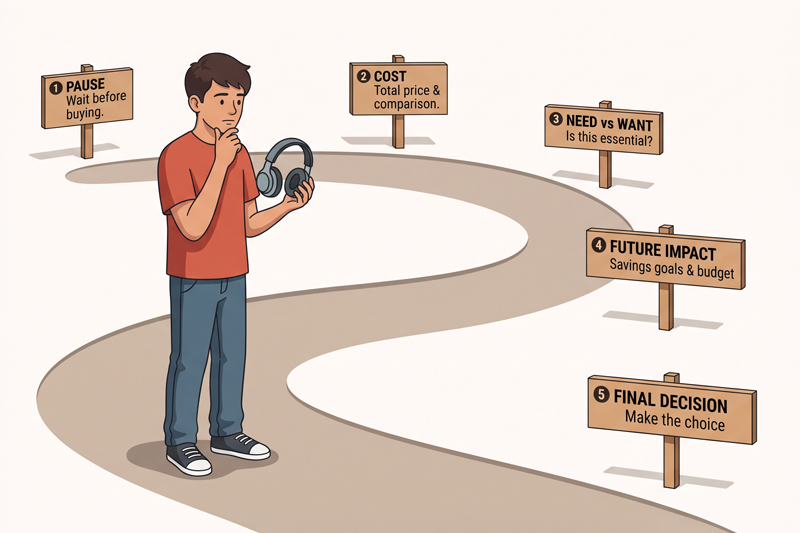
The THINK model is a simple decision-making routine that consists of five questions:
T — Take a Moment. The first question is, “Do I need to decide right now?” This step creates an opportunity to pause before making an impulsive purchase, especially when an item is appealing, emotionally exciting, or presented as a “Limited-Time Opportunity!” The purpose is to create space between wanting and acting.
H — How Much Will It Really Cost? The second question is, “What is the total cost?” This may include sales tax, shipping, fees, tips, or other hidden charges. This step requires attention, math, and mental manipulation by focusing on costs beyond the advertised price.
I — Is It a Need or a Want? After calculating the real cost, the focus moves to “Do I need this today?” Rather than teaching that wants are bad, we teach teens to distinguish between something necessary, something that can wait, and something that is simply desirable. This step supports prioritization and self-monitoring. Many things teens consider “needs” (such as smart phones) may be “wants” influenced by advertising.
N — What Happens Next? The autistic asks, “If I buy this today, what happens to my money tomorrow?” This question introduces future thinking. A purchase may be affordable in the moment but interferes with a future need. For example, spending $20 at a restaurant today may seem reasonable until the teen realizes that the same $20 is needed for groceries later in the week. I may ask the teen, rather than spending $20 on one meal, what could have been purchased at the grocery store for the same $20? This comparison teaches a cognitive skill—comparing today’s decision with tomorrow’s consequences.
K — Keep My Money or Spend It? The teen asks, “Is this the best use of my money?” This brings together decision-making and delayed gratification. The goal is not to teach teens never to spend money but to help them make intentional choices based on their needs, priorities, and available resources.
The THINK model reduces the cognitive demands associated with repeated financial decisions. Instead of treating every purchase as a new problem, the teen learns to use the same sequence of questions across financial dilemmas. The model uses rules to intentionally teach financial literacy, which there is limited research on. A 2025 systematic review (Schena et al., 2025) found only two studies that directly taught financial-literacy skills to autistic individuals, compared with 10 studies that addressed more basic money skills such as calculating change.
Applying THINK in Everyday Life
The strength of the THINK model is that it can be practiced in everyday situations. For example, a teen may bring enough money for a movie ticket at the mall, only to discover that their favorite store is having a “2 for 1 sale.” The teen must decide whether to spend the money at the store or save it for the movie. Instead of simply giving the teen more money, a parent can use the dilemma to practice THINK: Do I really need more clothes? What is the actual cost of the purchase? What happens if I spend the money planned for the movie? What alternatives are available? The situation becomes an opportunity for the teen to practice financial problem-solving and hopefully make a good decision.
The same routine can be applied anywhere. An autistic deciding whether to purchase a $15 item can practice determining the final cost, deciding whether the item is a need or a want, considering the remaining balance, and evaluating whether the purchase is the best use of available money. Repeated experiences help connect financial concepts to real-life consequences.
The model also works well with digital transactions. When money is represented by a number on a screen — like using a debit card at a grocery store or making an online purchase — rather than physical dollars and coins, the connection between spending and reduction in available money is less visible. Parents can make digital spending more concrete by showing the starting balance, purchase amount, and remaining balance. The goal is to make an abstract digital transaction more concrete through intentional thinking and problem solving.
Conclusion
Money literacy is an important foundation for independence but does not guarantee effective financial decision-making. Autistic teens may know how much money they have, recognize prices, and complete purchases, yet still need instruction in planning, prioritizing, and anticipating consequences. The limited research on financial-literacy instruction for autistic teens reinforces the need for practical approaches that move beyond basic money skills (Schena et al., 2025). Recent research also demonstrates the potential value of directly teaching spending, saving, budgeting, and banking skills to autistic teens (Wheeler et al., 2026).
The THINK Model offers an initial conceptual framework for helping parents teach cognitive skills through everyday experiences. By teaching teens how to think through decisions — not simply how to count money — parents help their teens build the planning, self-monitoring, and decision-making skills needed for greater financial independence. When paired with intentional decision-making instruction, financial literacy becomes more than knowledge about money; it becomes a practical skill for navigating everyday life.

Heidi Hillman is an autistic researcher and professor at Eastern Washington University. For more information, please contact Heidi Hillman at [email protected].
References
Board of Governors of the Federal Reserve System. (2026). Economic well-being of U.S. households in 2025.
Galizzi, M., Hillier, A., & Schena, D. II. (2023). Financial literacy among autistic adults. Journal of Consumer Affairs, 57(4), 1650–1683.
Kenny, L., Remington, A., & Pellicano, E. (2024). Everyday executive function issues from the perspectives of autistic adolescents and their parents: Theoretical and empirical implications. Autism, 28(9), 2204–2217.
Schena, D., Galizzi, M., Hillier, A., & Desruisseaux, J. (2025). Financial literacy skills instruction among autistic individuals: A systematic review. Journal of Autism and Developmental Disorders.
Wheeler, K. G., Favela, A. J., Hart, S. L., Hamrick, J., Dillard, M. K., & Whitmire, A. A. (2026). Teaching spending and saving to increase money management skills for young adults with autism. Career Development and Transition for Exceptional Individuals.