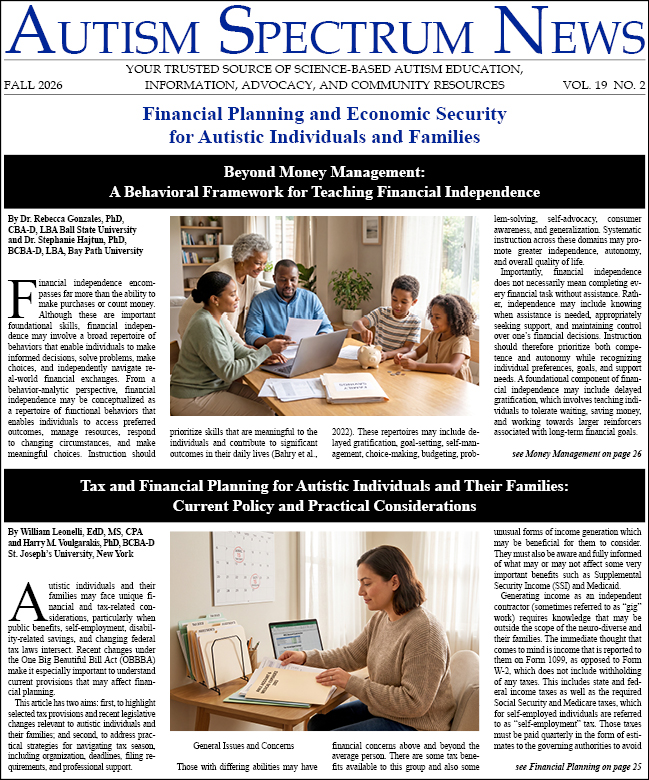
The transition from high school to the “real world” is often challenging and stressful for many young adults. This period involves a dramatic shift in expectations and experiences related to college and postsecondary education, employment, friendships and romantic relationships, independent living, healthcare navigation, and community participation. For autistic young adults, this may be further complicated by differences in social communication, executive functioning, and problem solving. Life after high school is often less structured than high school, and the formal supports available through an Individualized Education Plan (IEP) may end or change substantially, requiring young adults and their families to navigate new systems of support. It is therefore important that educational professionals, including speech-language pathologists (SLPs), help autistic students develop the functional skills they need to successfully transition from high school to life after school (White et al., 2024).
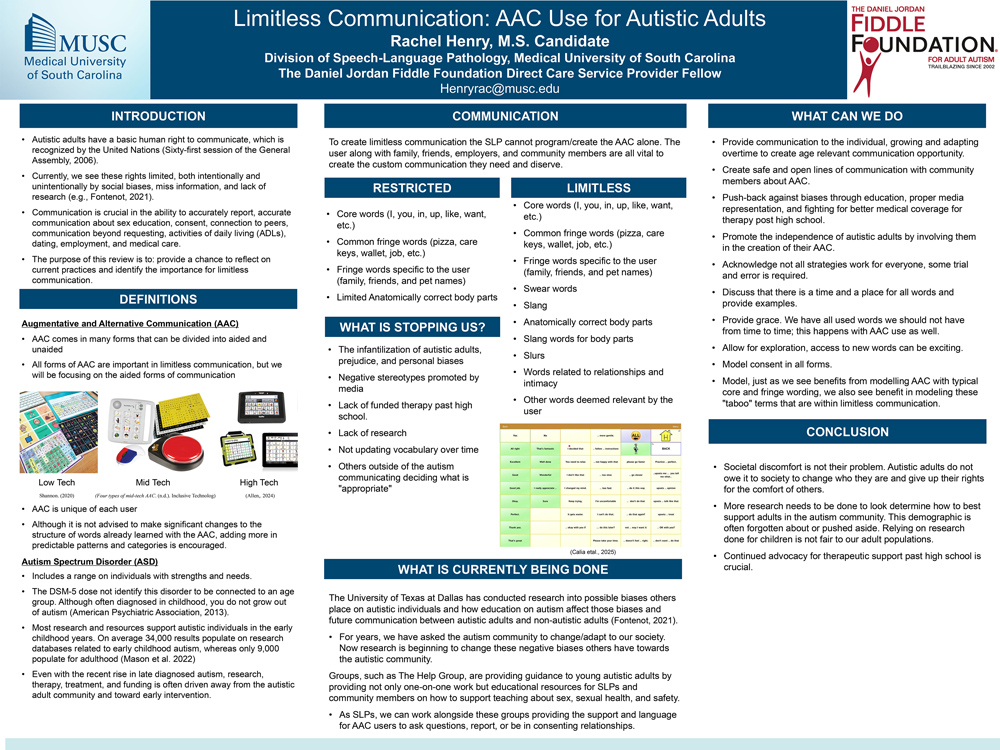
As a second-year speech-language pathology graduate student, I had the opportunity to complete a clinical rotation in a high school, working primarily with autistic adolescents and young adult students. During this experience, I witnessed firsthand the importance of supporting autistic adolescents and young adults in functional areas as they consider life after school. For example, Joe, an 11th grade student, was highly motivated to obtain a job after high school. He identified specific aspects of communication in social settings and “on-the-spot” problem solving that were challenging for him. This experience highlighted the importance of moving beyond isolated social skills and instead focusing on communication, problem-solving, and self-advocacy skills that can be applied across authentic settings.
Social Communication Considerations in the Workplace
Social communication is a broad term used to indicate how individuals communicate and interact with others. Although expectations for social communication vary across cultures, communities, relationships, and environments, it encompasses areas such as social interaction, social understanding, pragmatics, nonverbal communication, and language processing. Through a neuro-affirming lens, broad goals should focus on functional communication, autonomy, participation, and individual preferences rather than attempting to “fix” social differences (ASHA, n.d.). For example, these could include communicating needs effectively, initiating and maintaining relationships, expressing disagreements, asking for clarification, advocating for support, and repairing communication breakdowns. These skills are particularly important as young adults enter environments in which communication expectations may be less explicit and predictable than they were in school.
Importantly, social communication difficulties should not be viewed solely as deficits. The double empathy model proposes that communication breakdowns occur because of differences in perspectives and experiences among autistic and nonautistic individuals. This perspective has important implications for SLP practice. Instead of focusing on changing an autistic individual’s behavior, support should address communication-partner awareness, environmental accessibility, and strategies that support successful interactions with individuals with different communication styles (Milton, 2012).
Problem-Solving and Executive Functioning in the Workplace
Problem solving includes the ability to recognize a challenge, identify relevant information, generate and evaluate possible solutions, select an action, and adjust the approach when the initial solution is not successful. These skills are relevant to everyday situations. Examples could include: a coworker misunderstands something an employee says, a customer may become upset, a supervisor may provide an unexpected instruction, or a previously planned task may change.
Problem solving is closely related to executive functioning, which includes cognitive processes such as planning, organization, cognitive flexibility, inhibition, self-monitoring, and decision-making. For autistic individuals, success in these areas may depend on the complexity, predictability, and demands of the environment. Therefore, SLPs should consider not only whether a young adult can identify an appropriate response in a structured activity, but also whether they can generate and implement a response when faced with an unexpected situation in real life.
These skills are particularly important for employment because workplace environments frequently require employees to adapt to changing expectations, respond to unexpected situations, and determine when and how to seek assistance. Emerging research also suggests that executive-functioning challenges are associated with employment outcomes among autistic young adults. However, employment differences cannot be attributed to individual characteristics alone. Autistic young adults also encounter systemic and environmental barriers, including limited transition supports, challenging hiring practices, workplace expectations that may be poorly communicated, and inadequate accommodations (Yon-Hernandez et al., 2025).
Taken together, supporting problem-solving and executive functioning should involve opportunities to practice navigating authentic workplace challenges while also helping autistic young adults recognize their strengths and communicate their needs. Successful employment supports should consider individual skills and the broader environments in which employment occurs.
Self-Advocacy and Self-Determination
Another important consideration during the transition to adulthood is self-advocacy, which broadly encompasses understanding and communicating one’s needs, preferences, strengths, rights, and goals through an active role in making decisions. Self-advocacy is closely connected to self-determination, or the autonomy and agency to make meaningful choices and direct their lives.
Self-advocacy and self-determination are particularly important during the transition from high school to life after school (Martino et al., 2025). In the workplace, for example, self-advocacy may involve communicating how one learns best, requesting accommodations, clarifying expectations, addressing challenges, and identifying when additional support is needed. SLPs can support these skills by explicitly teaching and practicing skills, including asking questions, requesting clarification, communicating preferences, and advocating for accommodations. At the same time, self-advocacy should not be conceptualized as an additional burden placed solely on the autistic young adult. Effective self-advocacy depends on an environment that is responsive, accessible, and willing to listen and provide appropriate support (Clouder et al., 2023). Thus, SLPs and other educational professionals should consider both the individual’s communication skills and the communication demands and expectations of the environments in which they participate.
Putting These Skills Together: Joe’s Story
Because Joe was included in the transition planning process starting when he was in middle school, he and his family identified employment as an important post-secondary goal, and Joe expressed a specific interest in working at a gym because he loves physical activity and lifting weights. His educational team used this goal to develop experiences and objectives designed to prepare him for employment.
As a graduate student, I had the opportunity to work closely with Joe’s SLP to help support his social communication, problem solving, and executive functioning related to employment after high school. One strategy was connecting Joe with a mentor who was an autistic student getting ready to graduate from high school. This mentor relationship provided Joe with an opportunity to practice communication skills with a peer who shared some of his experiences. Joe and his mentor first brainstormed potential interview questions and developed responses. Then, they role-played an interview scenario where Joe was the interviewee and his mentor was the interviewer. The interview was recorded so that Joe, his mentor, my supervisor, and I could provide positive and constructive feedback on the interview. This process allowed Joe to reflect on his strengths, consider alternative responses, and identify areas for continued practice. Additionally, the mentorship provided a supported first step in making connections and growing a community outside of Joe’s typical community. As time went on, Joe indicated that he liked “hanging out” with his mentor and looked forward to seeing him.
The activities also extended beyond interview preparation. Joe and his mentor practiced initiating conversations and responding to conversation starters. They discussed how emotions and intentions can be communicated through verbal and nonverbal cues and considered how different responses may be interpreted in real-world situations. These activities provided opportunities to address communication, problem-solving, flexibility, and self-reflection within a meaningful context.
From Structured Practice to Real-World Participation
I learned so much during my clinical experience as a speech-language pathology graduate student in a high school. Based on this experience, I compiled the following recommendations that may be helpful for professionals supporting autistic young adults during the transition to adulthood.
- Focus on functional communication rather than isolated skills. When working on conversational skills, consider where, when, and how these skills will be used.
- Use age-appropriate and meaningful topics. Discuss communication related to dating and friendships, post-secondary education, puberty, employment, independent living, and healthcare.
- Include autistic young adults in the transition planning process. Identify their priorities, strengths, interests, preferences, and goals.
- Embed authentic contexts and real-life scenarios. Use activities that reflect the communication demands young adults will encounter in post-secondary education, employment, community settings, and relationships.
- Provide opportunities for mentorship. Mentor-mentee relationships may provide meaningful opportunities for social interaction, modeling, reflection, and connection with peers who have shared experiences.
- Use video-modeling and self-reflection. When appropriate, video-modeling can allow young adults opportunities to observe their own communication, identify strengths, and consider alternative strategies.
- Facilitate self-advocacy. Model and practice language for requesting support, clarifying expectations, communicating preferences, and requesting accommodations.
- Collaborate across settings and professionals. SLPs should work closely with families, educators, transition specialists, occupational therapists, counselors, employers, and community providers to ensure that communication goals are integrated into broader transition planning.
- Connect families and young adults with community resources. When available, provide updated information about community events, after-school day programs, job opportunities, mentoring programs, and other resources that support participation beyond the school environment.
As autistic young adults move into increasingly complex environments after high school, the goal is to support them with social communication, problem-solving, and self-advocacy tools that allow them to build relationships, navigate challenges, make choices, and participate meaningfully in their communities. While my time with Joe was relatively short, this experience had a profound and lasting impact on my clinical goals. It reinforced for me the importance of ongoing, functional support for autistic young adults as they transition to life after high school and navigate the unpredictable nature of different settings and contexts. This experience demonstrated that effective support begins with listening to young adults themselves, understanding what they want for their futures, and creating meaningful opportunities for them to develop the tools needed to pursue their goals.


Rachel Henry, MS, CF-SLP is a recent graduate of the Medical University of South Carolina Master of Science in Speech-Language Pathology program. As a student, she was The Daniel Jordan Fiddle Foundation 2025-2026 Adult Autism Direct Care Service Provider Fellow and conducted research on how speech-language pathologists can support autistic individuals’ transition from adolescence to adulthood and throughout adulthood.
Christina Pelatti, PhD, CCC-SLP is an associate professor and Director of the Division of Speech-Language Pathology at the Medical University of South Carolina. As a licensed and certified speech-language pathologist, Dr. Pelatti teaches and conducts research in the areas of oral and written language with children and young adults.
References
American Speech-Language-Hearing Association (n.d.). Components of social communication. https://www.asha.org/practice-portal/clinical-topics/social-communication-disorder/components-of-social-communication/
Clouder, L., Karakus, M., & Polat, F. (2023). Environmental interventions supporting autistic transition-age youth employability: A scoping review. Research in Autism Spectrum Disorders, 109, 102262. https://doi.org/10.1016/j.rasd.2023.102262
Martino, D., Brantley, A., & Scarpa, A. (2025). The role of self-advocacy and self-determination in positive adjustment for autistic adolescents and young adults: A mini-review. Frontiers in Child and Adolescent Psychiatry, 4, https://doi.org/10.3389/frcha.2025.1542543
Milton, D. E. M. (2012). On the ontological status of autism: The ‘double empathy problem.’ Disability & Society, 27(6), 883–887. https://doi.org/10.1080/09687599.2012.710008
White, L. M., Adams, D., Simpson, K., Malone, S. A., & colleagues. (2025). Transitioning on from secondary school for autistic students: A systematic review. Autism in Adulthood, 7(4). https://doi.org/10.1089/aut.2023.0193
Yon-Hernandez, J. A., Gonzales, C., Bothra, S., Kecskemeti, K., Iosif, A. M., Takarae, Y., McGurk, S. R., Mueser, K. T., & Solomon, M. (2025). Early employment outcomes in autistic and non-autistic youth: Challenges and opportunities. Journal of Autism and Developmental Disorders. https://doi.org/10.1007/s10803-025-07001-9